
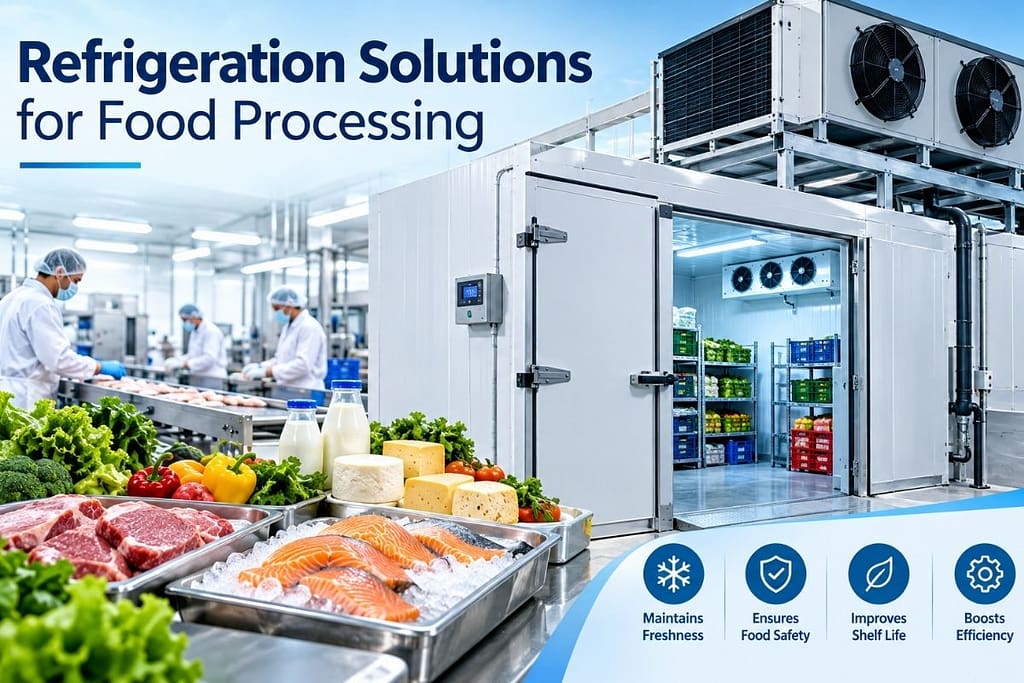
Quick Answer: Refrigeration solutions for food processing maintain safe temperatures, protect product quality, reduce spoilage, and support efficient storage, processing, freezing, and distribution of food products.
The food processing industry in India handles products such as dairy, meat, seafood, fruits, vegetables, frozen foods, beverages, bakery products and ready-to-eat meals. Since many of these products are highly sensitive to temperature, reliable refrigeration is an essential part of food processing operations.
An effective refrigeration system does much more than simply make a room cold. It helps control temperature and humidity, slows microbial growth, preserves freshness, supports freezing processes and maintains the required conditions throughout the cold chain. A properly designed Cold Storage Cooling System can therefore play an important role in maintaining food safety and reducing product losses.
For Indian food processors, refrigeration requirements can vary considerably depending on the product, processing method, storage period, room size and local climatic conditions. Selecting the right equipment and maintaining it properly can improve operational efficiency while helping businesses meet food safety and quality requirements.
5 Key Units of Refrigeration Solutions for Food Processing
- Cold Storage Refrigeration Equipment – Includes compressors, condensers, evaporators, controls and other components required for temperature-controlled storage.
- Cold Storage Evaporator – Removes heat from the cold room and helps maintain the required temperature for stored products.
- Cold Storage Cooling System – Provides controlled cooling for storage, processing and temperature-sensitive food applications.
- Condensing Unit – Combines the compressor and condenser functions and rejects heat removed from the refrigerated space.
- Refrigeration Controls and Monitoring – Helps operators maintain stable temperatures and identify abnormal operating conditions.
What Are Refrigeration Solutions for Food Processing?
Refrigeration solutions for food processing are systems and equipment designed to remove heat from food products, processing areas and storage spaces. They are used at different stages, including receiving, processing, chilling, freezing, cold storage and distribution.
Depending on the application, a food processing facility may require chilled rooms operating above freezing, freezer rooms below 0°C, blast freezers for rapid freezing, process cooling systems or specialised refrigeration equipment for individual production lines.
The system should be designed according to the actual heat load rather than simply selecting equipment based on room size. Product temperature, quantity, door openings, lighting, people, machinery and ambient conditions can all influence refrigeration requirements.
Why Is Refrigeration Important in Food Processing?
Temperature control is critical because many food products can deteriorate rapidly when stored under unsuitable conditions. Higher temperatures can accelerate microbial activity, chemical reactions and moisture loss, affecting the safety, texture, appearance and shelf life of food.
A suitable refrigeration system helps businesses:
- Maintain required product temperatures
- Reduce spoilage and wastage
- Preserve freshness and quality
- Support hygienic food processing
- Improve cold-chain management
- Extend the storage life of suitable products
- Maintain consistent processing conditions
- Reduce unnecessary energy consumption when correctly designed
In India, where ambient temperatures can become particularly high during summer, refrigeration equipment must also be selected and installed with local climatic conditions in mind.
Major Cold Storage Refrigeration Equipment
A complete refrigeration installation normally consists of several interconnected components. The exact configuration depends on the application and required operating temperature.
Compressor
The compressor is one of the main components of a refrigeration system. It circulates refrigerant through the system and increases the refrigerant pressure before it moves towards the condenser.
For commercial and industrial food processing applications, compressor selection should consider refrigeration capacity, operating conditions, refrigerant type, efficiency and expected operating hours.
Condenser
The condenser rejects the heat absorbed from the refrigerated space. Depending on the application, air-cooled or water-cooled condenser arrangements may be used.
Proper condenser airflow and cleanliness are important because restricted heat rejection can increase operating pressure and reduce system efficiency.
Cold Storage Evaporator
The Cold Storage Evaporator is installed inside the refrigerated room or process area. Refrigerant absorbs heat as it passes through the evaporator, thereby reducing the temperature of the surrounding air.
Evaporator selection depends on factors such as room temperature, humidity requirements, product type, air circulation and required cooling capacity. Correct sizing helps maintain consistent temperatures without unnecessary energy consumption.
Expansion Device
The expansion valve or other expansion device regulates the flow of refrigerant into the evaporator and reduces its pressure. Proper refrigerant control is important for efficient evaporator operation.
Refrigeration Controls
Temperature controllers, sensors, pressure controls and other monitoring devices help maintain stable operating conditions. Modern systems may also include digital monitoring and alarms, allowing operators to identify temperature deviations quickly.
How Does a Cold Storage Cooling System Work?
A typical refrigeration cycle involves four primary stages: compression, condensation, expansion and evaporation.
First, the compressor receives low-pressure refrigerant vapour from the evaporator and compresses it into a high-pressure, high-temperature vapour.
The refrigerant then enters the condenser, where heat is rejected to the surrounding environment. As heat is removed, the refrigerant changes into a high-pressure liquid.
Next, the liquid refrigerant passes through the expansion device. Its pressure and temperature are reduced before it enters the evaporator.
Inside the evaporator, the refrigerant absorbs heat from the cold room or processing area. The refrigerant then returns to the compressor, and the cycle continues.
This continuous heat-transfer process allows the Cold Storage Cooling System to maintain the required temperature.
Refrigeration Applications in Food Processing
Different food products require different refrigeration arrangements.
Dairy Processing
Milk, curd, paneer, cheese and other dairy products require controlled temperature conditions at various stages. Refrigeration may be used for raw milk storage, processing areas and finished-product storage.
Meat and Seafood
Meat and seafood require careful temperature management because they are highly perishable. Chilling, freezing and cold storage systems may be used according to the product and processing requirements.
Fruits and Vegetables
Cold storage can help slow deterioration and preserve product quality. However, the required temperature and humidity depend on the particular fruit or vegetable.
Frozen Food
Frozen foods require low-temperature storage to maintain their frozen condition. Freezer rooms and specialised freezing systems must be designed according to product load and required freezing conditions.
Bakery and Ready-to-Eat Products
Refrigeration can be used for ingredients, intermediate products and finished goods. Controlled cooling can also be important for maintaining product consistency and shelf life.
Choosing a Cold Room Equipment Manufacturer
Selecting the right Cold Room Equipment Manufacturer is an important decision for food processing businesses. Equipment should not be selected only on initial purchase price. Businesses should also evaluate system efficiency, product quality, technical support, installation expertise, spare-parts availability and maintenance services.
A reliable manufacturer should understand the application’s temperature requirements and provide equipment suitable for the expected operating conditions.
The manufacturer should also consider insulation, door usage, heat load, evaporator selection, condenser capacity, compressor requirements and control systems before recommending a solution.
Role of Components of Air Conditioning System in Refrigeration
Although refrigeration and air conditioning have different applications, they share several fundamental principles and equipment types. Understanding the components of air conditioning system can help explain how heat-transfer systems work.
Common components include compressors, condensers, expansion devices and evaporators. In both refrigeration and air-conditioning applications, these components work together to transfer heat from one location to another.
However, food processing refrigeration systems are generally designed around specific product temperatures, humidity requirements, hygienic considerations and industrial operating conditions.
Improving Refrigeration Efficiency
Energy consumption is an important consideration for Indian food processing facilities because refrigeration equipment may operate continuously.
Businesses can improve efficiency by:
- Maintaining clean condenser and evaporator surfaces
- Checking refrigerant and system operating conditions
- Minimising unnecessary cold-room door opening
- Maintaining proper insulation
- Using suitable temperature controls
- Servicing compressors and motors regularly
- Checking for air leakage around doors
- Monitoring energy consumption
- Selecting correctly sized equipment
- Preventing excessive ice accumulation where applicable
Regular preventive maintenance can also help identify problems before they result in product losses or major equipment failures.
Conclusion
Reliable refrigeration solutions for food processing are essential for maintaining food quality, supporting safe handling practices and reducing avoidable product losses. From compressors and condensers to a Cold Storage Evaporator, expansion devices and temperature controls, every component has an important role in the refrigeration cycle.
For Indian food processing businesses, the right Cold Storage Refrigeration Equipment should be selected according to product requirements, operating temperatures, heat load, facility conditions and expected usage. Working with an experienced Cold Room Equipment Manufacturer can help businesses develop a refrigeration system that delivers consistent cooling, operational reliability and better energy performance.
Ultimately, refrigeration should be viewed as an important part of the complete food-processing and cold-chain infrastructure rather than simply as a method of keeping products cold.
Frequently Asked Questions
1. What are refrigeration solutions for food processing?
Refrigeration solutions for food processing are systems used to control temperature during food processing, chilling, freezing, cold storage and distribution. They help protect food quality and reduce spoilage.
2. What equipment is used in food processing refrigeration?
Common equipment includes compressors, condensers, evaporators, expansion devices, refrigeration controls, cold rooms and associated piping and monitoring systems.
3. What is the function of a Cold Storage Evaporator?
A Cold Storage Evaporator absorbs heat from the cold room or refrigerated area. This heat-transfer process helps maintain the required storage temperature.
4. How can a food processing facility reduce refrigeration energy consumption?
Proper equipment sizing, good insulation, regular maintenance, clean heat-transfer surfaces, controlled door opening and appropriate temperature settings can help improve refrigeration efficiency.
5. How do I choose a Cold Room Equipment Manufacturer?
Consider the manufacturer’s technical experience, equipment quality, application knowledge, installation support, maintenance services, spare-parts availability and ability to design the system according to your specific refrigeration requirements.