
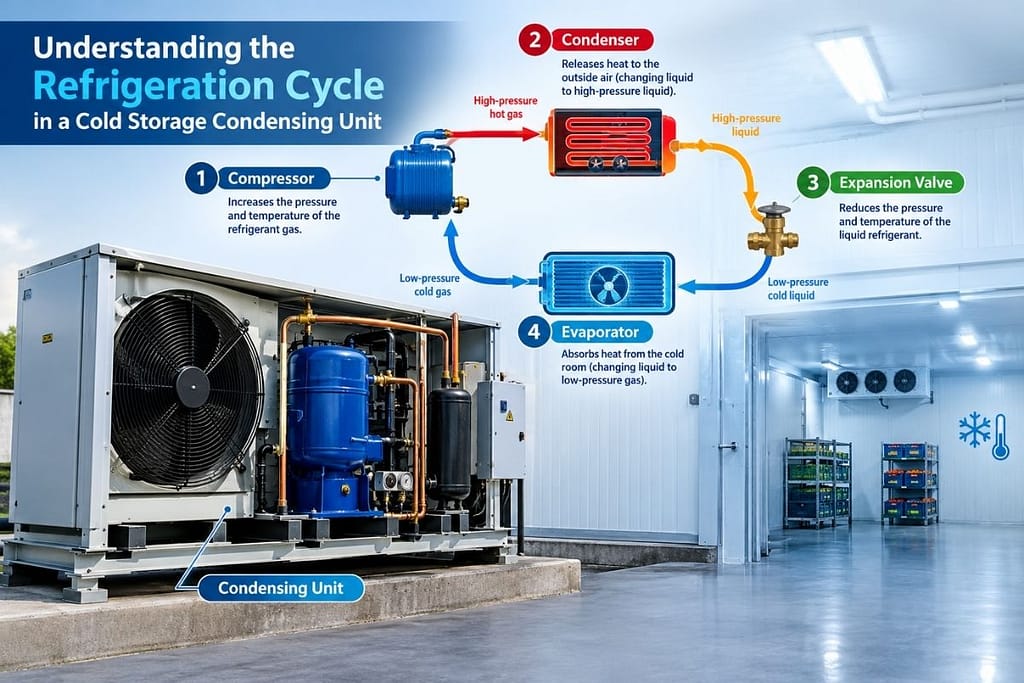
Quick Answer – A cold storage condensing unit transfers heat from the cold room through compression, condensation, expansion and evaporation to maintain the required storage temperature.
Introduction
Cold storage facilities play an important role in India’s food, pharmaceutical, dairy, meat, seafood and agricultural industries. These facilities need reliable temperature control to protect products from spoilage and maintain their quality throughout storage.
The refrigeration system is at the centre of this process. A typical system consists of a cold storage condensing unit, evaporator, expansion device, refrigerant piping and various controls. Together, these components continuously remove heat from the storage area and reject it to the surrounding environment.
Understanding how the refrigeration cycle works can help cold storage operators, facility managers and businesses make better decisions regarding equipment selection, maintenance and energy efficiency.
This article explains the four fundamental stages of the refrigeration cycle—compression, condensation, expansion and evaporation—and examines how they work together in a modern cold storage cooling system.
5 Key Units of the Refrigeration Cycle
- Compressor – Compresses low-pressure refrigerant vapour and increases its pressure and temperature.
- Condenser – Removes heat from the refrigerant and converts the high-pressure vapour into liquid.
- Expansion Device – Reduces refrigerant pressure and regulates its flow into the evaporator.
- Cold Storage Evaporator – Absorbs heat from the cold room and allows the refrigerant to evaporate.
- Controls and Accessories – Pressure controls, receivers, filters, valves, fans and other components support safe and reliable system operation.
What Is a Cold Storage Condensing Unit?
A condensing unit is one of the most important assemblies in a refrigeration installation. It generally contains the compressor, condenser and associated components required to circulate and condense the refrigerant.
Its primary job is to receive low-pressure refrigerant vapour returning from the evaporator, compress it and reject the heat carried by the refrigerant to the outside environment.
The condensing unit normally works together with an evaporator installed inside the cold room. While the evaporator absorbs heat from the refrigerated space, the condensing unit helps transfer that heat outside.
The selection of a condensing unit depends on several factors, including:
- Required cold room temperature
- Refrigeration load
- Room dimensions
- Type of stored product
- Ambient temperature
- Refrigerant type
- Operating pressure
- Required cooling capacity
Therefore, selecting equipment based only on room size may not provide an accurate refrigeration solution.
Understanding the Refrigeration Cycle
The refrigeration cycle is essentially a continuous heat-transfer process. The refrigerant circulates through different components, changing its pressure, temperature and physical state along the way.
The four fundamental stages are:
Compression → Condensation → Expansion → Evaporation
After completing these stages, the refrigerant returns to the compressor and the cycle begins again.
Let us understand each stage in detail.
1. Compression: Increasing Refrigerant Pressure
The cycle begins when low-pressure refrigerant vapour returns from the evaporator to the compressor.
The compressor draws in this vapour and compresses it. During compression, the refrigerant’s pressure and temperature increase significantly.
The refrigerant leaves the compressor as a high-pressure, high-temperature vapour and moves towards the condenser.
The compressor is often described as the driving force of the refrigeration system because it maintains the pressure difference required for continuous refrigerant circulation.
For cold storage applications, compressor selection is particularly important. The compressor may need to operate for extended periods, especially in facilities where products must remain within a specific temperature range.
An incorrectly sized compressor can result in poor temperature control, excessive energy consumption or unnecessary mechanical stress.
2. Condensation: Rejecting Heat
The hot, high-pressure refrigerant vapour then enters the condenser.
The condenser transfers heat from the refrigerant to the surrounding environment. In an air-cooled system, condenser fans move ambient air across the condenser coil to improve heat transfer.
As the refrigerant loses heat, it changes from a high-pressure vapour into a high-pressure liquid.
This stage is particularly important in Indian conditions. During summer, outdoor temperatures can become quite high in many parts of the country. Higher ambient temperatures make it more difficult for the condenser to reject heat.
For this reason, proper condenser sizing, sufficient ventilation and regular cleaning are important considerations when designing a Cold Storage Refrigeration Equipment installation.
A condenser covered with dust or dirt may have reduced heat-transfer efficiency. Similarly, restricted airflow around the condensing unit can increase operating pressure.
3. Expansion: Reducing Refrigerant Pressure
After condensation, the high-pressure liquid refrigerant passes through an expansion device.
Depending on the system design, this may be a thermostatic expansion valve (TXV), electronic expansion valve or another suitable metering device.
The expansion device performs two important functions:
- It reduces the pressure of the refrigerant.
- It controls the amount of refrigerant entering the evaporator.
When the pressure drops, the refrigerant’s saturation temperature also decreases. This allows it to absorb heat effectively when it reaches the evaporator.
The expansion device therefore acts as an important control point between the high-pressure and low-pressure sides of the refrigeration system.
Incorrect refrigerant flow can affect evaporator performance and may contribute to unstable cooling conditions. Proper selection and adjustment should therefore be carried out according to the system design and manufacturer’s specifications.
4. Evaporation: Absorbing Heat from the Cold Room
The low-pressure refrigerant then enters the cold storage evaporator.
The evaporator is normally positioned inside the cold room or within the air circulation arrangement. Fans can circulate cold air across the evaporator coil, allowing heat to transfer from the room air to the refrigerant.
As the refrigerant absorbs heat, it changes from a low-pressure liquid or liquid-vapour mixture into a low-pressure vapour.
This is the stage where heat is actually removed from the cold storage space.
For example, consider a cold room storing fresh vegetables. Heat can enter the room through the walls, ceiling, doors, product loading and air infiltration. The evaporator absorbs this heat and transfers it into the refrigerant.
The refrigerant then returns to the compressor, completing the cycle.
How Does a Cold Storage Cooling System Work?
A cold storage cooling system works by continuously moving heat rather than simply creating cold air.
The basic process can be represented as:
Cold Room → Evaporator → Compressor → Condenser → Expansion Device → Evaporator
In simple terms:
- The evaporator absorbs heat from the cold room.
- The compressor increases the refrigerant pressure.
- The condenser releases the absorbed heat outside.
- The expansion device reduces refrigerant pressure.
- The low-pressure refrigerant returns to the evaporator.
- The process repeats continuously.
This cycle allows the cold room to remain at the required operating temperature.
Cold Storage Evaporator and Its Importance
The evaporator is particularly important because it directly interacts with the refrigerated environment.
A cold storage evaporator needs to provide sufficient heat-transfer capacity for the application. Its selection depends on factors such as room temperature, refrigerant, airflow, product load and required cooling capacity.
Air movement is another important consideration. Evaporator fans distribute cooled air throughout the room and help maintain relatively uniform temperatures.
However, excessive airflow is not necessarily suitable for every application. Certain products can lose moisture or suffer quality problems if exposed to unsuitable air movement or temperature conditions.
Therefore, evaporator selection should consider both refrigeration capacity and the requirements of the stored product.
Cold Storage Refrigeration Equipment: Important Components
A complete refrigeration installation involves more than just a compressor and condenser.
Common Cold Storage Refrigeration Equipment includes:
- Condensing units
- Evaporators
- Compressors
- Condensers
- Expansion valves
- Refrigerant piping
- Refrigeration controllers
- Temperature sensors
- Pressure switches
- Filter-driers
- Liquid receivers
- Solenoid valves
- Evaporator fans
- Defrost systems
The exact combination depends on the application and system design.
When sourcing equipment, businesses may work with a Cold Room Equipment Manufacturer that can recommend suitable refrigeration components based on room size, temperature requirements, product load and operating conditions.
How Is Refrigeration Different from Air Conditioning?
Refrigeration and air conditioning use similar fundamental principles, but their applications and operating requirements can differ considerably.
For example, many components of air conditioning system designs include compressors, condensers, expansion devices and evaporators. These components also appear in refrigeration systems because both technologies use the vapour-compression cycle in many applications.
However, cold storage systems are specifically designed to maintain controlled conditions for stored products. Depending on the application, they may need to operate at chilled or freezing temperatures for extended periods.
Air conditioning, on the other hand, primarily focuses on maintaining comfortable indoor conditions for people.
Therefore, components should not simply be selected interchangeably without considering operating temperature, cooling load, refrigerant requirements and application conditions.
Factors Affecting Cold Storage Refrigeration Performance
Several factors influence how efficiently a refrigeration system operates.
Ambient Temperature
Higher outdoor temperatures can increase the workload on the condenser and compressor.
Insulation
Good-quality insulation helps reduce heat entering the cold room and lowers the refrigeration load.
Door Opening
Frequent door opening allows warm and humid outside air to enter the room, increasing the cooling requirement.
Product Load
Products entering the room may carry significant heat, particularly if they have not been pre-cooled.
Evaporator Condition
Ice accumulation, dirt or restricted airflow can reduce evaporator performance.
Condenser Condition
Dust accumulation and poor ventilation can reduce heat rejection and increase operating pressure.
These factors should be considered when evaluating the performance of a cold storage cooling system.
Common Refrigeration Cycle Problems
High Condensing Pressure
High condensing pressure can be associated with high ambient temperatures, dirty condenser coils, inadequate airflow or other system-related issues.
Low Suction Pressure
Low suction pressure can result from restricted refrigerant flow, inadequate airflow through the evaporator or other operating problems. A proper diagnosis is necessary before making adjustments.
Excessive Evaporator Frost
Frost can restrict airflow and reduce heat transfer. Moisture infiltration, defrost problems and unsuitable operating conditions can contribute to excessive frost formation.
Compressor Overheating
Compressor overheating can occur due to several factors, including high operating temperatures, inadequate cooling, incorrect system conditions or mechanical problems.
These symptoms should be investigated by a qualified refrigeration technician rather than assuming that a particular component is responsible.
Maintenance Tips for Cold Storage Refrigeration Equipment
Regular maintenance is essential for maintaining refrigeration performance and reducing unexpected downtime.
Important maintenance practices include:
- Clean condenser coils regularly.
- Check condenser fan operation.
- Inspect electrical connections.
- Monitor suction and discharge pressures.
- Check refrigerant piping for signs of leakage.
- Inspect evaporator fans.
- Check defrost operation.
- Keep the condensing unit area clear.
- Monitor cold room temperature.
- Inspect insulation for damage.
- Maintain service and temperature records.
Maintenance schedules should follow equipment manufacturer recommendations and should also consider the operating environment.
Why Proper Equipment Selection Matters
Choosing suitable refrigeration equipment is essential for long-term performance.
A system that is too small may struggle to maintain the required temperature, while an unnecessarily oversized system may result in inefficient operation and higher initial costs.
A professional Cold Room Equipment Manufacturer or refrigeration specialist can assess factors such as room dimensions, insulation, product load, ambient conditions, operating temperature and required pull-down time before recommending equipment.
This approach is more reliable than selecting equipment based solely on horsepower or room volume.
Conclusion
The refrigeration cycle is the foundation of a modern cold storage cooling system. It uses four primary processes—compression, condensation, expansion and evaporation—to continuously transfer heat from the cold room to the surrounding environment.
The cold storage condensing unit plays a vital role by compressing the refrigerant and helping reject heat through the condenser, while the cold storage evaporator absorbs heat from the refrigerated space.
For Indian applications, factors such as high ambient temperatures, insulation quality, door openings, product load and maintenance can significantly influence system performance. Selecting appropriate Cold Storage Refrigeration Equipment and maintaining each component properly can help improve reliability, temperature control and operational efficiency.
Frequently Asked Questions
1. What is a cold storage condensing unit?
A cold storage condensing unit is an assembly that generally includes the compressor, condenser and related components. It compresses refrigerant and helps reject heat absorbed from the cold storage space.
2. What are the four stages of the refrigeration cycle?
The four basic stages are compression, condensation, expansion and evaporation. These stages work continuously to transfer heat from the refrigerated space to the surroundings.
3. What is the function of a cold storage evaporator?
The cold storage evaporator absorbs heat from the cold room. Refrigerant flowing through the evaporator absorbs this heat and changes into vapour.
4. What equipment is used in cold storage?
Common equipment includes condensing units, evaporators, compressors, condensers, expansion valves, refrigeration controls, fans, refrigerant piping and defrost systems.
5. Why is condenser maintenance important in India?
High ambient temperatures can make heat rejection more difficult. Dirt, restricted airflow and poor ventilation can further affect condenser performance, so regular inspection and cleaning are important.
6. What factors affect cold storage cooling requirements?
Room size, insulation, product quantity, product temperature, door openings, ambient conditions, lighting, people entering the room and required storage temperature can all influence the refrigeration load.
7. Can air-conditioning equipment be used for cold storage?
Not necessarily. Although many components of air conditioning system designs use the same basic refrigeration principles, cold storage applications can require different temperature ranges, capacities, controls and equipment specifications. The system should be selected according to the actual refrigeration application.