
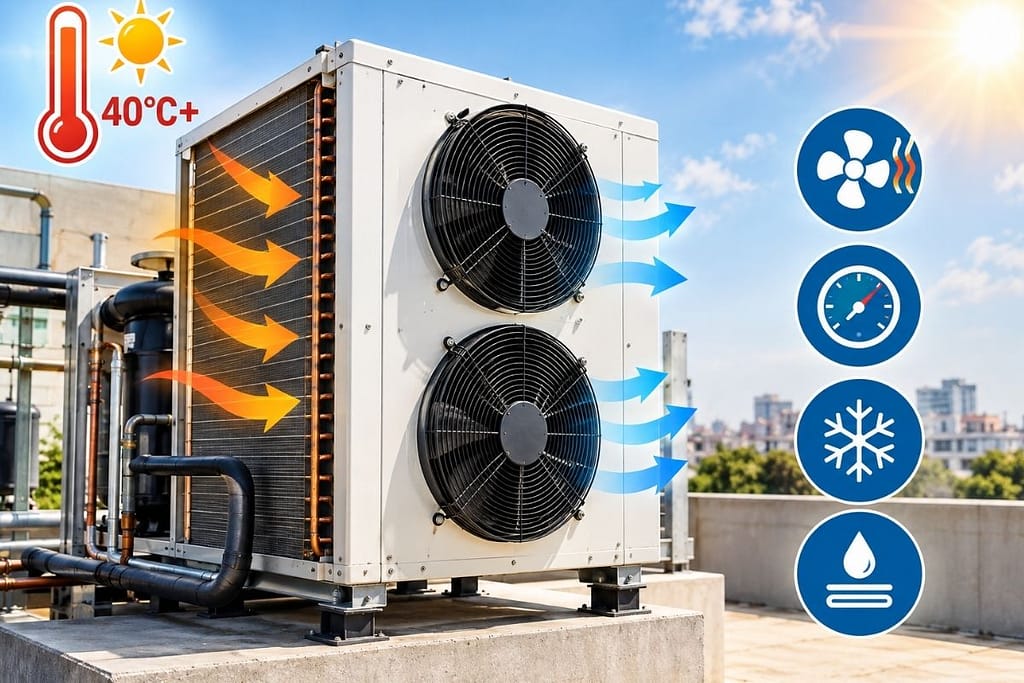
Quick Answer: Refrigeration condensing units face higher heat loads in Indian summers, which can increase condensing pressure, energy consumption and compressor stress unless properly selected and maintained.
India’s summer conditions can be demanding for refrigeration systems. In many parts of the country, ambient temperatures can rise well above 40°C, while industrial areas, rooftops, plant rooms and poorly ventilated spaces can become even hotter. Under these conditions, a refrigeration condensing unit has to remove heat from the refrigerant and reject it to an already hot environment.
This makes summer one of the most important periods for evaluating the performance, reliability and efficiency of a refrigeration system.
A condensing unit is responsible for a major part of the refrigeration cycle. It generally consists of a compressor, condenser, receiver, and associated controls and components. The compressor circulates refrigerant through the system, while the condenser rejects the heat absorbed from the refrigerated space along with the heat generated during compression.
When outdoor temperatures increase, the condenser has to work harder to release this heat. If the unit is not correctly selected for Indian climatic conditions, the system may consume more electricity, operate at higher discharge pressure, struggle to maintain the required room temperature, and experience greater component wear.
For cold rooms, food processing facilities, dairy plants, pharmaceutical storage, supermarkets, and industrial refrigeration applications, understanding this summer performance is therefore essential.
5 Key Points to Know About Summer Performance
- High ambient temperature increases condensing temperature and pressure.
- Compressor power consumption generally rises as condensing pressure increases.
- Poor condenser airflow can make summer performance significantly worse.
- Correct equipment selection and adequate capacity are critical for reliable cooling.
- Regular cleaning, refrigerant checks and electrical maintenance can improve summer reliability.
Why Indian Summer Conditions Are Challenging for Refrigeration Systems
The refrigeration cycle depends on transferring heat from a low-temperature area to the surrounding environment. The condenser must reject this heat effectively.
During mild weather, the temperature difference between the condenser and ambient air can be sufficient for efficient heat rejection. However, when ambient temperature increases, the condenser has less temperature difference available for rejecting heat.
For example, if the surrounding air is already very hot, the refrigerant needs to condense at a temperature significantly higher than the ambient air. This raises the condensing pressure of the system.
As condensing pressure rises, the compressor has to work against a higher pressure difference. This increases compressor work and can result in higher electrical consumption.
The impact becomes particularly important in regions such as Rajasthan, Gujarat, Delhi-NCR, Maharashtra, Telangana, Andhra Pradesh, Tamil Nadu, and other areas where high summer temperatures are common.
What Happens to a Condensing Unit at High Ambient Temperature?
The performance of a refrigeration condensing unit during summer can be understood through several interconnected effects.
1. Condensing Pressure Increases
The most important effect of high ambient temperature is an increase in condensing temperature and pressure.
A condenser cannot normally condense refrigerant at a temperature below the surrounding air temperature. Therefore, as ambient temperature rises, the system’s condensing temperature generally has to rise as well.
Higher condensing pressure means the compressor must work harder to move refrigerant through the system.
This can affect:
- Compressor efficiency
- Electrical power consumption
- Discharge temperature
- Refrigeration capacity
- Overall system reliability
The exact effect depends on the refrigerant, compressor type, evaporating temperature, condenser design, airflow, and system operating conditions.
2. Compressor Power Consumption Can Rise
One of the most noticeable summer effects is increased electricity consumption.
When the condensing pressure increases, the compressor operates with a higher compression ratio. More work is required to compress the refrigerant vapour from the evaporating pressure to the higher condensing pressure.
As a result, the compressor may draw more electrical power.
This is especially important for commercial and industrial refrigeration facilities because refrigeration equipment may operate continuously for long periods. Even a moderate increase in power consumption can become significant over an entire summer season.
A properly designed system should therefore be evaluated at realistic summer design conditions rather than only at mild ambient temperatures.
3. Refrigeration Capacity May Reduce
High condensing pressure can also affect the cooling capacity of the refrigeration system.
As condensing pressure rises, the refrigerant leaving the condenser can have a higher enthalpy and the refrigeration effect may change. Depending on the system and operating conditions, the compressor’s usable refrigeration capacity can decrease.
This may lead to longer running times.
For a cold room, this can become noticeable when the system struggles to pull down the temperature after frequent door openings or after loading warm products.
In extreme conditions, the system may run almost continuously while still failing to maintain the desired temperature.
How Condenser Airflow Affects Summer Performance
Airflow is critical for an air-cooled system.
An Air Cooled Condensing Unit depends on fans to move ambient air across the condenser coil. If the coil is dirty, the fins are blocked, or the fan is not operating correctly, heat rejection becomes difficult.
During summer, this problem becomes even more serious because the incoming air is already hot.
Common causes of inadequate airflow include:
- Dust and dirt accumulation on condenser coils
- Blocked fan guards
- Damaged condenser fins
- Incorrect fan rotation
- Faulty fan motors
- Insufficient clearance around the unit
- Recirculation of hot discharge air
- Installation in enclosed or poorly ventilated locations
The condenser should have adequate clearance around it so that it can draw in cooler ambient air and discharge hot air without recirculation.
Importance of Condensing Unit Installation Location
Installation location can have a major influence on summer performance.
An outdoor unit installed directly under strong sunlight may experience additional heat exposure. More importantly, a unit installed near walls, other condensers, exhaust outlets or enclosed structures may repeatedly draw in hot air discharged from its own condenser.
This phenomenon is known as hot-air recirculation.
An Outdoor Condensing Unit should therefore be positioned where sufficient airflow is available. The manufacturer’s recommended clearances should be followed, and the discharge air should have a clear path away from the condenser.
For large refrigeration plants, installation planning should consider the location of multiple condensing units, prevailing airflow, and heat rejection from other equipment.
Selecting the Right Condensing Unit for Indian Summers
Equipment selection is one of the most important factors affecting summer performance.
A unit should not simply be selected according to its nominal refrigeration capacity. The selection should consider the actual operating conditions, including:
- Required room temperature
- Evaporating temperature
- Expected ambient temperature
- Refrigerant
- Condensing temperature
- Cooling load
- Product loading pattern
- Door-opening frequency
- Defrost requirements
- Compressor operating range
- Condenser capacity
- Electrical supply conditions
For example, a unit selected for a moderate ambient condition may not deliver the same performance when the ambient temperature rises considerably.
A reliable Condensing Unit Manufacturer India should therefore consider the intended operating environment and application while recommending equipment rather than selecting a system based only on catalogue capacity.
Commercial and Industrial Applications
Different refrigeration applications have different operating requirements.
A Commercial Condensing Unit may be used for supermarkets, restaurants, display refrigeration, small cold rooms and other commercial applications. These systems often experience frequent door openings and changing loads.
An Industrial Condensing Unit, on the other hand, may be used for large cold storage facilities, food processing plants, dairy operations, distribution centres and manufacturing facilities. These applications can involve high cooling loads and long operating hours.
The summer design conditions become particularly important in industrial installations because equipment failure can result in product losses, production interruptions and significant energy costs.
Role of Compressor Selection
The compressor is the heart of the condensing unit, and its selection influences how effectively the system operates under different conditions.
A Scroll Compressor Condensing Unit can be suitable for various commercial and light-industrial applications because scroll compressors are widely used in refrigeration and air-conditioning systems where their operating envelope matches the application.
However, compressor selection should always be based on the actual refrigeration duty, refrigerant, suction and discharge conditions, and the manufacturer’s operating envelope.
For low-temperature applications, selecting a compressor without considering its suitability for the required evaporating temperature can lead to excessive discharge temperature, poor performance or premature failure.
Cold Storage Performance During Summer
Cold storage facilities face a particularly important challenge because they often need to maintain stable temperatures despite high outdoor temperatures and substantial product movement.
A Cold Storage Condensing Unit needs to cope not only with ambient heat but also with heat entering through doors, walls, ceilings, product loading, and people movement.
For example, when warm products are introduced into a cold room, the refrigeration system must remove the additional sensible and latent heat. If the condenser is simultaneously operating under very high ambient conditions, the overall load on the refrigeration system becomes more demanding.
Good insulation, properly designed doors, suitable air curtains where required, and disciplined operating practices can therefore reduce the load placed on the refrigeration equipment.
Maintenance Practices Before the Summer Season
Preventive maintenance should ideally be completed before peak summer conditions arrive.
Clean the Condenser Coil
Dust and dirt act as an additional barrier to heat transfer. A dirty coil can increase condensing pressure and reduce system efficiency.
The condenser should be cleaned using an appropriate method that does not damage the fins.
Check Condenser Fans
Fan motors, blades, bearings, controls, and electrical connections should be inspected.
A single failed fan can significantly affect a multi-fan condenser, particularly during high ambient conditions.
Check Refrigerant Charge
Incorrect refrigerant charge can affect system performance.
Both undercharging and overcharging can create operating problems, although the symptoms differ depending on the system design and operating conditions. Refrigerant charging should therefore be performed according to the manufacturer’s procedure and appropriate service practices rather than simply adding refrigerant based on pressure alone.
Inspect Electrical Components
High summer loads can expose weaknesses in electrical systems.
Technicians should inspect:
- Contactors
- Overload protection
- Terminal connections
- Capacitors where applicable
- Voltage stability
- Current draw
- Control wiring
Electrical connections should be properly tightened and inspected as part of preventive maintenance.
Check Oil and Compressor Condition
The compressor should be checked for abnormal noise, vibration, oil-related issues, and operating temperature.
Repeated high discharge temperatures can indicate an underlying system problem and should not be ignored.
Energy Efficiency During Indian Summer
Summer efficiency is not determined by the condensing unit alone.
The entire refrigeration system contributes to energy consumption. Insulation quality, evaporator performance, expansion-device operation, defrost control, condenser airflow, and compressor loading all have an influence.
Operators can also reduce unnecessary refrigeration load by:
- Minimising cold-room door opening time
- Maintaining good insulation
- Avoiding unnecessary entry into cold rooms
- Keeping condenser areas unobstructed
- Cleaning coils regularly
- Maintaining correct room temperatures
- Avoiding excessive product loading
- Monitoring operating pressures and temperatures
Where appropriate, modern controls such as condenser fan speed control and floating head-pressure strategies can also help reduce energy consumption, provided they are correctly designed and compatible with the refrigeration system.
Signs That a Condensing Unit Is Struggling in Summer
Operators should pay attention to warning signs such as:
- Increasing discharge pressure
- Higher compressor current
- Longer compressor running time
- Increasing discharge temperature
- Frequent high-pressure trips
- Poor cold-room pull-down
- Unusual compressor noise
- Excessive vibration
- Higher-than-normal electricity consumption
- Insufficient cooling during peak afternoon temperatures
These symptoms do not automatically indicate a condenser problem. A refrigeration technician should diagnose the complete system because similar symptoms can result from refrigerant, airflow, compressor, expansion-device, evaporator or load-related issues.
Why Summer Design Conditions Should Be Considered at the Planning Stage
A refrigeration system should be designed around realistic operating conditions rather than ideal laboratory conditions.
For Indian installations, engineers and facility owners should consider the expected peak ambient temperature of the location, the installation environment and the required refrigeration duty.
Oversizing is not always the best answer either. Excessive oversizing can increase initial cost and may create inefficient operating conditions at low loads. The objective should be to select and configure the equipment appropriately for the actual application.
This is particularly important for businesses where refrigeration operates throughout the year but experiences significantly different ambient conditions between winter and summer.
Conclusion
Refrigeration condensing units can perform reliably during India’s hot summer conditions when they are correctly selected, installed, operated and maintained. However, high ambient temperatures naturally place additional pressure on the refrigeration cycle.
As outdoor temperature increases, condensing pressure generally rises, compressor work increases, and energy consumption can go up. At the same time, refrigeration capacity may be affected, particularly when condenser airflow is restricted, or the equipment is operating close to its limits.
For this reason, summer performance should be considered from the design stage itself. Correct condenser sizing, adequate ventilation, proper installation clearance, suitable compressor selection and preventive maintenance can make a substantial difference.
For cold storage, food processing, dairy, pharmaceutical, and commercial refrigeration applications, investing attention in condenser performance before peak summer can help reduce breakdowns, maintain stable temperatures, and control operating costs.
The key lesson is simple: a refrigeration system designed for India’s summer conditions is more likely to deliver dependable cooling when temperatures are at their highest.
Frequently Asked Questions (FAQs)
1. Does high ambient temperature affect refrigeration condensing unit performance?
Yes. High ambient temperature generally increases condensing temperature and pressure. This can increase compressor power consumption and may reduce refrigeration capacity depending on the operating conditions.
2. Why does a condensing unit consume more electricity in summer?
The compressor normally has to operate against a higher condensing pressure when the ambient temperature is high. This increases the work required by the compressor and can increase electrical consumption.
3. How can I improve condensing unit performance during summer?
Keep the condenser coil clean, ensure proper fan operation, provide sufficient airflow and installation clearance, maintain the correct refrigerant charge and monitor operating pressures and temperatures.
4. Can a dirty condenser affect cold-room temperature?
Yes. A heavily contaminated condenser may not reject heat effectively. This can increase condensing pressure and make it difficult for the refrigeration system to maintain the required cold-room temperature.
5. Is condenser location important in Indian summer conditions?
Yes. The unit should have sufficient airflow and should not continuously draw in hot air discharged from its own condenser or nearby equipment. Proper installation clearance is important.
6. Should refrigeration equipment be selected according to summer ambient temperature?
Yes. Expected peak ambient conditions should be considered during equipment selection and system design. Selecting equipment only according to nominal cooling capacity can result in inadequate performance under demanding summer conditions.
7. Can high condensing pressure damage a compressor?
Persistently high condensing pressure can increase compressor operating stress and discharge temperature and may contribute to reduced reliability. A high-pressure condition should be investigated rather than repeatedly reset without identifying the cause.
8. How often should condenser coils be cleaned?
There is no single interval suitable for every installation. Dusty industrial environments may require more frequent cleaning than relatively clean locations. The coil should be inspected regularly and cleaned whenever contamination begins to restrict heat transfer or airflow.
9. Is a bigger condensing unit always better for summer?
No. The unit should be correctly sized for the actual refrigeration load and operating conditions. Oversizing can increase capital cost and may not provide the best efficiency across varying loads.
10. What is the most important factor for summer condensing unit performance?
There is no single factor. Correct equipment selection, adequate condenser capacity, sufficient airflow, appropriate installation, proper refrigerant conditions, and regular maintenance all work together to determine summer performance.