
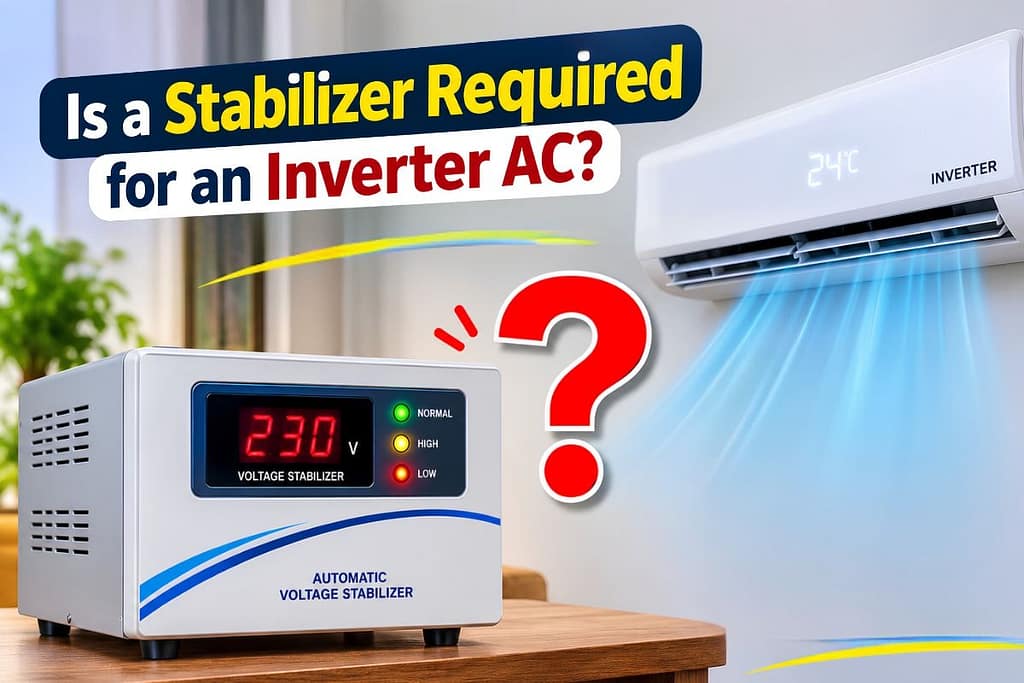
Quick Answer: An inverter AC does not always require an external voltage stabilizer. Many modern inverter air conditioners have a built-in voltage protection system and can operate across a specified voltage range. However, a separate stabilizer may be necessary if your area’s voltage fluctuates significantly or the AC manufacturer’s instructions recommend one.
Introduction
Inverter air conditioners are popular because they offer energy-efficient cooling, quieter operation and better temperature control than many conventional air conditioning systems. Unlike traditional ACs, which typically switch their compressors on and off, inverter ACs adjust compressor speed according to the cooling demand.
Despite these advantages, many homeowners ask an important question: Is a stabilizer required for an inverter AC?
The answer depends on the AC model, its operating voltage range and the quality of your electricity supply. Some inverter ACs can handle moderate voltage fluctuations without an external stabilizer, while others may need additional protection in areas with unstable power.
Understanding how inverter technology works, what built-in protection offers and when an external stabilizer is useful can help you make the right decision.
1. Do Inverter ACs Have Built-In Voltage Protection?
Many modern inverter air conditioners include electronic protection systems designed to manage certain electrical irregularities. These systems monitor operating conditions and may shut down the unit when voltage moves outside its permitted range.
Some models are marketed as stabiliser-free because they can operate across a relatively wide input voltage range. However, the exact range differs between manufacturers and models.
Built-in protection may include:
- Overvoltage and undervoltage protection
- Compressor overload protection
- Temperature monitoring
- Protection against excessive electrical current
- Automatic shutdown during certain abnormal conditions
These features can reduce the need for an external stabilizer, but they do not guarantee protection against every power problem. Always check the manufacturer’s specifications and installation manual before deciding to operate an inverter AC without one.
2. When Is a Stabilizer Required for an Inverter AC?
A separate stabilizer may be useful when your home experiences frequent or severe voltage fluctuations. This is particularly relevant in areas where the electricity supply becomes unstable during peak summer demand.
Consider installing an external stabilizer if:
- Your local supply regularly falls below or rises above the AC’s rated operating range.
- Lights frequently dim or become unusually bright.
- The air conditioner repeatedly displays voltage-related errors or shuts down.
- The manufacturer specifically recommends an external stabilizer.
- A qualified electrician identifies persistent supply voltage problems.
An external stabilizer should be selected according to the AC’s electrical requirements, including its capacity, input voltage range and starting or operating current.
It is also important to distinguish between voltage fluctuations and other electrical issues. A stabilizer will not necessarily resolve problems caused by poor wiring, loose connections, inadequate earthing or frequent power cuts.
3. What Are the Benefits of Using a Stabilizer with an Inverter AC?
A correctly selected voltage stabilizer can help maintain a suitable output voltage when the incoming supply varies within the stabilizer’s correction range.
Its potential benefits include:
Additional voltage protection: It can reduce the effects of certain overvoltage and undervoltage conditions.
Support for reliable operation: Maintaining voltage within the required range can help prevent some voltage-related interruptions.
Reduced risk from supply fluctuations: An appropriately rated stabilizer can provide an additional layer of protection for electrical equipment.
Greater confidence in unstable supply conditions: It may be useful in locations where voltage regularly moves outside the AC’s normal operating range.
An Electronic Voltage Stabilizer can be considered for this purpose, provided its ratings and protection features are appropriate for the specific air conditioner. It should complement the AC’s built-in protection rather than replace proper electrical installation and safety devices.
4. How to Choose the Right Stabilizer for an Inverter AC
If your air conditioner needs an external stabilizer, selecting the correct model is essential. A stabilizer with insufficient capacity or an unsuitable input range may fail to provide the expected protection.
Check these factors before purchasing:
- AC capacity: Consider whether the unit is rated at 1 ton, 1.5 tons, 2 tons or another capacity.
- Voltage range: Choose a stabilizer that can handle the lowest and highest supply voltages experienced at your property.
- Load capacity: Confirm that its electrical rating supports the AC’s requirements.
- Protection features: Look for suitable overload, overvoltage and undervoltage protection.
- Compatibility: Follow the air conditioner’s manufacturer recommendations.
- Installation quality: Ensure proper wiring, earthing and circuit protection.
Do not select a stabilizer based on tonnage alone. Two air conditioners with the same cooling capacity may have different electrical specifications.
5. Does an Inverter AC Need a Stabilizer in Every Location?
No. The requirement varies according to the local electricity supply and the particular AC model.
In areas with a relatively stable supply, an inverter AC with a sufficiently wide operating voltage range may work without an external stabilizer. In locations with frequent voltage fluctuations, additional protection may be advisable.
Before purchasing a stabilizer, check the AC’s rated input voltage and permissible operating range. If the supply frequently falls outside those limits, ask a qualified electrician to assess the problem.
If voltage fluctuations are severe, the underlying electrical issue should be investigated instead of relying solely on a stabilizer.
6. What About Commercial and Industrial Air Conditioning Systems?
Voltage protection is also important in larger refrigeration and HVAC installations, although the equipment requirements differ from those of residential inverter ACs.
A central air conditioning system may contain compressors, pumps, fans, electronic controllers and other components with different electrical requirements. Voltage protection must be selected according to the entire system’s design and the specifications of individual components.
Similarly, an Industrial Condensing Unit used in commercial refrigeration may require appropriate protection for its compressor and control equipment. In cold storage applications, a Cold Storage Evaporator works as part of a wider refrigeration system, where dependable electrical operation supports temperature management.
An Industrial Evaporator may also incorporate fans, motors and control devices that require a suitable electrical supply.
Businesses working in refrigeration and HVAC, including pragya refrigeration, should consider voltage stability alongside equipment ratings, electrical protection, installation conditions and maintenance requirements when planning industrial systems.
Residential stabilizer recommendations should not automatically be applied to industrial equipment, which may require engineered protection solutions.
7. Stabilizer vs Surge Protector: What Is the Difference?
A voltage stabilizer regulates voltage within its designed operating range. A surge protector is primarily intended to limit the effects of short-duration voltage spikes.
These devices perform different functions. A stabilizer does not necessarily provide comprehensive protection against lightning-related surges, while a basic surge protector cannot continuously correct sustained low or high voltage.
Depending on the installation, suitable circuit breakers, surge protection devices, earthing and other protective equipment may be needed alongside a stabilizer.
Conclusion
An inverter AC does not automatically require an external stabilizer. Many modern models include built-in voltage protection and can operate across a specified voltage range. However, an external stabilizer may be beneficial when the electricity supply is unstable or the manufacturer recommends additional protection.
Check your air conditioner’s manual, understand the voltage conditions at your property and consult a qualified electrician if fluctuations are frequent. Choosing protection based on actual electrical requirements is more effective than purchasing a stabilizer simply because the AC uses inverter technology.
Frequently Asked Questions
1. Can I run an inverter AC without a stabilizer?
Yes, if the manufacturer’s specifications permit it and your electricity supply remains within the AC’s acceptable voltage range.
2. Does a 1.5-ton inverter AC need a stabilizer?
Not necessarily. The requirement depends on the model’s voltage tolerance, electrical specifications and local supply conditions.
3. Can a stabilizer improve inverter AC performance?
It can help maintain suitable voltage when the incoming supply fluctuates within its correction range, but it does not directly improve the AC’s cooling capacity or energy efficiency.
4. Is a stabilizer better than built-in voltage protection?
Neither is universally better. Built-in protection is designed for the specific AC, while an external stabilizer may offer additional voltage regulation when needed. Follow the manufacturer’s recommendations and assess the quality of your power supply.