
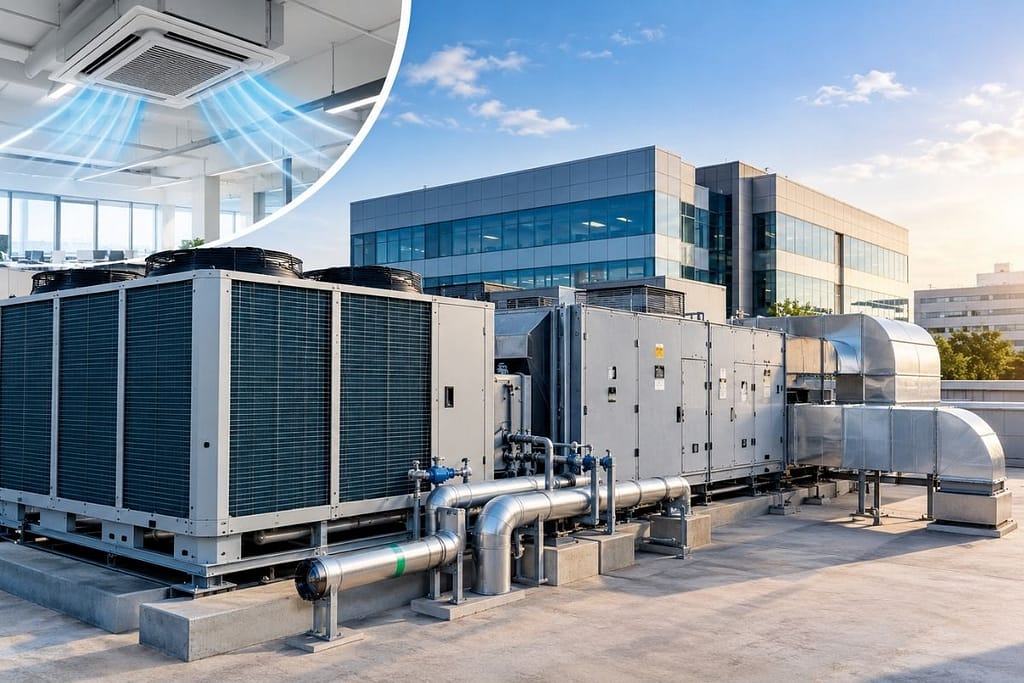
A central air conditioning system is a cooling solution designed to maintain comfortable temperatures across multiple rooms or large indoor spaces. Commonly used in commercial buildings, offices, hospitals, hotels, shopping centres, and industrial facilities, it provides controlled cooling through a central unit and a network of ducts or chilled-water pipes.
As buildings become more focused on energy efficiency and indoor comfort, understanding the system’s components, working principles, and applications helps businesses make informed HVAC decisions.
What Is a Central Air Conditioning System?
A central air conditioning system is an HVAC solution that cools air at a central location and distributes it throughout a building. Depending on the design, it may use chilled water supplied by a chiller or refrigerant-based technology to remove heat from indoor spaces.
Unlike individual room air conditioners, central systems can serve multiple areas through connected air-handling equipment and distribution networks. This makes them suitable for buildings that require consistent temperature control, planned ventilation, and centralised operation.
The system’s capacity and configuration depend on factors such as building size, occupancy, heat load, climate, and operating requirements.
How Does a Central Air Conditioning System Work?
A central air conditioning system works by transferring heat from indoor spaces to the external environment. Its operation generally involves the following steps:
- Air circulation: Return air from indoor spaces is drawn into an air-handling unit, where filters help remove dust and other airborne particles.
- Heat removal: The air passes over a cooling coil. In a chilled-water system, chilled water absorbs heat from the air; in a direct-expansion system, refrigerant performs the cooling.
- Air distribution: The cooled air is circulated through ducts and supplied to different rooms through grilles and diffusers.
- Heat rejection: The heat collected during cooling is released outdoors through the appropriate condenser or heat-rejection equipment.
- Temperature regulation: Thermostats, sensors, valves, and control panels help maintain the desired indoor temperature.
The exact process varies according to the type of central air conditioning system installed.
What Are the Main Components of an Air Conditioning System?
Understanding the components of air conditioning system designs is essential when selecting equipment for commercial and industrial applications. Each component performs a specific function and must work efficiently with the others.
1. Compressor
The compressor increases the pressure of refrigerant vapour and circulates it through the refrigeration circuit. Its capacity and operating characteristics influence the cooling performance and energy consumption of the equipment.
2. Condenser
The condenser releases heat absorbed from the indoor environment. Depending on the system design, it may use ambient air or water to remove heat from the refrigerant.
3. Evaporator or Cooling Coil
The evaporator absorbs heat from the air or process being cooled. In central systems, cooling coils are commonly installed within air-handling units or fan-coil units.
4. Expansion Device
The expansion valve regulates refrigerant flow and reduces its pressure before it enters the evaporator. This supports the continuous refrigeration cycle.
5. Air Handling Unit (AHU)
An air handling unit circulates and conditions air. Depending on the design, it can include filters, cooling coils, fans, dampers, and controls.
6. Ductwork and Air Distribution
Ducts, grilles, and diffusers distribute conditioned air throughout the building. Correct sizing and installation help maintain suitable airflow and minimise unnecessary pressure losses.
7. Pumps, Pipes, and Controls
Chilled-water systems require suitable pumps, piping, valves, and associated controls. Electrical control panels and temperature sensors help coordinate equipment operation and protect system performance.
Types of Central Air Conditioning Systems
Different buildings require different cooling configurations. The most suitable option depends on the cooling load, available space, installation budget, and maintenance requirements.
- Chilled-water systems: A central chiller cools water, which is circulated to air-handling units or fan-coil units. These systems are commonly considered for large buildings and facilities with substantial cooling demands.
- Air-cooled systems: These systems reject heat directly to the outdoor air through a condenser or air-cooled chiller. They can be suitable where cooling-tower infrastructure or a continuous condenser-water supply is impractical.
- Water-cooled systems: These systems use water to remove heat from the refrigeration equipment, typically alongside a cooling tower or another suitable heat-rejection arrangement.
- VRF or VRV systems: Variable refrigerant flow systems use refrigerant to provide cooling or heating across multiple indoor units, with capacity controlled according to demand.
- Packaged and ducted systems: These systems combine major cooling components in a packaged unit or connect indoor and outdoor equipment to distribute conditioned air through ductwork.
Each configuration offers different benefits, so professional load calculations and equipment selection are important before installation.
Why Is an Air-Cooled Condensing Unit Important?
An Air Cooled Condensing Unit rejects heat to the surrounding air and typically incorporates a compressor, condenser coil, and fan, along with the necessary controls and other components.
It can be used in compatible refrigeration systems and certain air conditioning applications where air-based heat rejection is appropriate. Unlike water-cooled arrangements, it does not require a condenser-water circuit or cooling tower for its primary heat-rejection process.
When choosing a unit, businesses should consider cooling capacity, ambient operating temperatures, airflow clearance, refrigerant compatibility, energy consumption, and maintenance access. The final selection should match the requirements of the complete system rather than relying on capacity alone.
Choosing an Air Cooler Unit Manufacturer for HVAC Applications
Selecting a reliable Air Cooler Unit Manufacturer is important when planning equipment for commercial, industrial, or specialised cooling applications. Buyers should assess product specifications, construction quality, heat-transfer performance, operating conditions, and compatibility with the intended installation.
It is also important to distinguish between an air cooler, an air-handling unit, and an air-cooled condensing unit. These products perform different functions and are not interchangeable. The correct equipment depends on whether the application requires air circulation, air conditioning, refrigeration, or process cooling.
Businesses should request technical documentation and confirm the operating requirements before purchasing HVAC equipment.
Benefits of a Well-Designed Central Air Conditioning System
A properly designed central air conditioning system offers several advantages:
- Consistent comfort: Helps maintain controlled temperatures across multiple rooms and occupied areas.
- Centralised management: Allows operators to monitor and regulate equipment from a central control arrangement.
- Flexible system design: Can be configured for different building layouts and cooling loads.
- Space management: May reduce the need for separate room-level outdoor units, depending on the chosen design.
- Indoor air management: Compatible filtration and ventilation arrangements can support better indoor air quality.
- Operational efficiency: Correct equipment sizing, suitable controls, and preventive maintenance can help reduce avoidable energy use.
Actual performance depends on system design, building conditions, equipment efficiency, operating schedules, and maintenance practices.
Why Consider Pragya Refrigeration for Cooling Equipment?
Pragya Refrigeration & Electricals Pvt. Ltd. works in the HVAC and refrigeration equipment sector, with products including evaporators, condensing units, heat exchangers, and control panels. Its ENZO product range includes refrigeration equipment intended for commercial and industrial applications.
When planning a central air conditioning or associated cooling installation, businesses can evaluate suitable equipment according to their technical requirements, operating environment, and system configuration. The important step is to ensure that each selected component is compatible with the complete installation.
For specialised requirements, consult the manufacturer or a qualified HVAC professional to establish the necessary capacity, operating conditions, and equipment specifications.
Frequently Asked Questions
1. What is the main purpose of a central air conditioning system?
Its main purpose is to cool and condition air centrally and distribute it to multiple rooms or zones within a building.
2. What are the four basic refrigeration components?
The four basic components are the compressor, condenser, expansion device, and evaporator. Larger central systems may also require air-handling units, pumps, piping, ductwork, and advanced controls.
3. Is an air-cooled condensing unit suitable for every central AC system?
No. Suitability depends on the system design, cooling load, refrigerant circuit, operating conditions, and equipment compatibility. Some central systems use chilled-water plants or other configurations.
4. How can central air conditioning efficiency be improved?
Efficiency can be improved through correct system sizing, clean filters and coils, proper airflow, suitable temperature settings, well-maintained equipment, and effective control strategies.
5. What should businesses consider before choosing HVAC equipment?
Businesses should assess cooling requirements, equipment capacity, energy performance, installation space, operating temperatures, maintenance access, and compatibility with other system components.
Conclusion
A central air conditioning system is an important solution for maintaining indoor comfort in large commercial and industrial spaces. Its performance depends on the correct combination of refrigeration equipment, cooling coils, air-handling units, distribution networks, and control systems.
By understanding the components of air conditioning system designs and selecting compatible equipment, businesses can plan more reliable and efficient cooling installations. Pragya Refrigeration & Electricals Pvt. Ltd. offers HVAC and refrigeration equipment that businesses can evaluate for suitable cooling applications based on their specific technical requirements.