
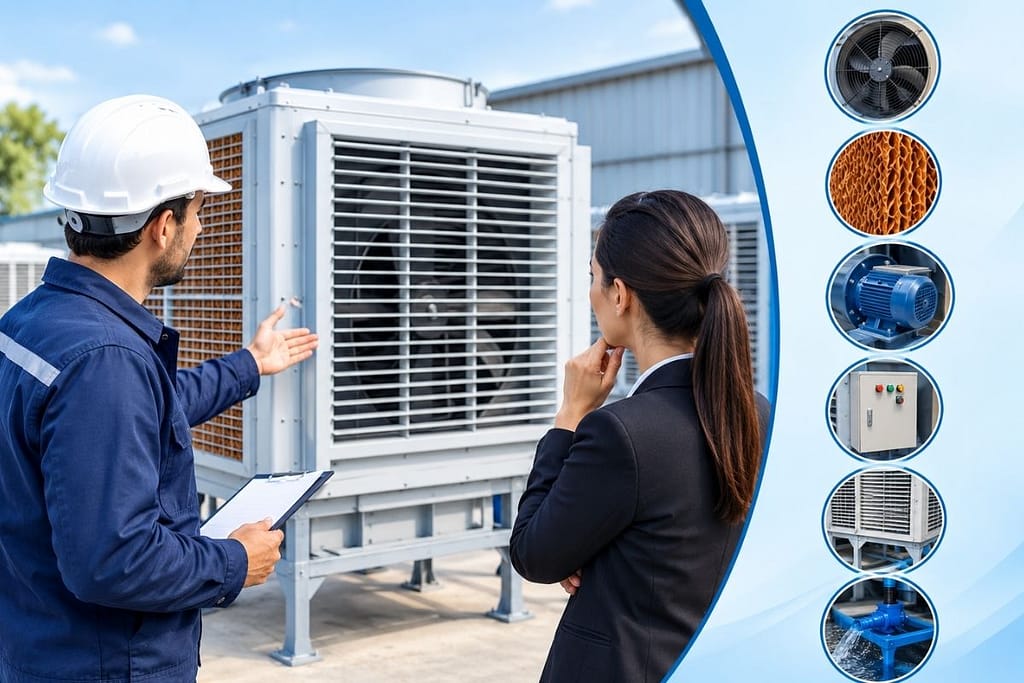
Quick Answer: Before buying an air cooler unit, ask about cooling capacity, power consumption, materials, warranty, maintenance, customisation, certifications, delivery, and after-sales support.
Choosing the right air cooler unit is not simply about comparing prices or selecting the model with the largest cooling capacity. For homes, shops, offices, warehouses, workshops, and industrial spaces, the performance of an air cooler depends on several factors, including the unit’s design, airflow, operating conditions, construction quality and suitability for the intended application.
This becomes particularly important in India, where summer temperatures can become extremely high in many regions. A cooler that performs well in moderate conditions may not provide the same results when exposed to high ambient temperatures, dusty environments or continuous operation.
Whether you are purchasing one unit or planning a larger cooling installation, speaking directly with the manufacturer can help you understand what you are actually buying. Asking the right questions also makes it easier to compare different manufacturers and avoid unexpected operating or maintenance costs later.
For businesses looking for industrial refrigeration solutions, it is also useful to understand how the manufacturer approaches related equipment such as condensing systems, compressors and heat rejection systems.
5 Key Things to Check Before Buying
- Cooling capacity: Make sure the unit is suitable for the size and heat load of your application.
- Construction quality: Check the materials used for the body, cooling pads, fan and water system.
- Energy consumption: Ask for realistic power-consumption figures under operating conditions.
- Maintenance and service: Understand cleaning requirements, spare-parts availability and service support.
- Warranty and reliability: Confirm warranty coverage and what is included or excluded.
1. What Cooling Capacity Do I Need for My Application?
This should be one of the first questions you ask the manufacturer.
Air coolers are available in different capacities, and the appropriate model depends on factors such as room or area size, ceiling height, ventilation, occupancy, heat-generating equipment and local climate.
For example, a cooler intended for a small shop will have different requirements from one used in a factory, warehouse or large commercial space.
Ask the manufacturer to recommend a unit based on your actual application rather than simply selling you a standard model.
You can provide details such as:
- Area or volume of the space
- Indoor and outdoor temperature
- Number of people using the area
- Heat-producing machinery
- Required airflow
- Ventilation conditions
- Expected operating hours
A professional manufacturer should be able to explain why a particular capacity is appropriate.
2. What Type of Materials Are Used to Manufacture the Unit?
The construction material has a direct impact on durability, corrosion resistance and maintenance requirements.
Ask whether the unit uses galvanised steel, stainless steel, aluminium, engineered plastics or other materials. For industrial applications, the material should be appropriate for the environment in which the cooler will operate.
You should also ask about the quality of:
- Cooling pads
- Water tanks
- Fan blades
- Motors
- Pumps
- Electrical components
- Fasteners and fittings
- Protective coatings
If the unit will operate in a humid, dusty or chemically exposed environment, material selection becomes even more important.
A low-cost unit may initially look attractive, but poor-quality materials can result in corrosion, leakage, frequent repairs and a shorter service life.
3. How Much Electricity Does the Air Cooler Consume?
Energy consumption is an important consideration, especially for commercial and industrial users operating cooling equipment for long hours.
Do not only ask for the motor’s rated power. Ask the manufacturer about the total electrical consumption of the complete unit, including the fan, pump and other electrical components where applicable.
You can also ask:
- What is the motor rating?
- What is the expected operating power?
- Is a high-efficiency motor available?
- Does the unit support speed control?
- What will the approximate running cost be?
The actual electricity cost will depend on your tariff and operating schedule, so the manufacturer’s figures should be treated as technical guidance rather than a guaranteed monthly bill.
4. Is the Unit Suitable for India’s Climate?
India has significantly different climatic conditions across regions. A cooling unit used in a dry and hot region may have different performance characteristics from one used in a humid coastal area.
Ask the manufacturer how the unit performs under the conditions found at your location.
This is particularly important because evaporative cooling works most effectively when the surrounding air has relatively lower humidity. In humid conditions, the cooling effect can be reduced.
A good manufacturer should discuss environmental conditions honestly rather than promising the same cooling performance everywhere.
5. What Airflow and Fan Technology Does the Unit Use?
Airflow is just as important as cooling capacity.
Ask the manufacturer for the unit’s airflow rating and find out how the air is distributed throughout the space. Depending on the application, different fan designs and configurations may be available.
Also ask about:
- Fan type
- Airflow volume
- Fan speed
- Noise level
- Motor efficiency
- Air distribution pattern
- Continuous operating capability
For a large warehouse or industrial facility, poor air distribution can create hot spots even when the cooler itself has sufficient nominal capacity.
6. How Easy Is the Unit to Clean and Maintain?
Regular maintenance is essential for maintaining cooling performance.
Dust, dirt, mineral deposits and biological growth can accumulate in the water circuit, tank, pump and cooling pads. If these components are not maintained properly, airflow and cooling performance can deteriorate.
Before purchasing, ask:
- How frequently should the cooling pads be cleaned?
- How often should the water tank be drained?
- Can the pump be easily accessed?
- How are cooling pads replaced?
- Are spare parts readily available?
- Can routine servicing be performed locally?
A manufacturer that provides clear maintenance instructions can save you considerable time and money over the operating life of the equipment.
7. Can the Unit Be Customised for My Requirement?
Standard models may not always be suitable for specialised industrial or commercial applications.
Ask whether the manufacturer provides customisation for dimensions, airflow, motor configuration, controls, mounting arrangements or other requirements.
This is especially useful when the equipment needs to integrate with an existing ventilation or cooling system.
If you are comparing refrigeration equipment from the same supplier, you may also come across products such as a Commercial Condensing Unit, Industrial Condensing Unit or Outdoor Condensing Unit. These are refrigeration components rather than evaporative air coolers, so make sure you understand the difference before selecting equipment.
8. What Warranty Do You Provide?
Warranty terms can tell you a lot about a manufacturer’s confidence in its product.
Do not simply ask, “Is there a warranty?” Ask for the complete warranty terms in writing.
Find out:
- Warranty duration
- Which components are covered
- Whether labour is included
- Whether transportation is covered
- What conditions can void the warranty
- How warranty claims are processed
Motors, pumps, electrical controls and other components may have different warranty conditions, so understanding these details before purchase is important.
9. Do You Provide After-Sales Service and Spare Parts?
After-sales support can become more important than the initial purchase price once the equipment is installed.
Ask the manufacturer whether it has service technicians or authorised service partners in your region. You should also check how quickly commonly required spare parts can be supplied.
This is particularly important for businesses where cooling equipment operates continuously and an unexpected breakdown can affect production, workers or inventory.
When evaluating a refrigeration supplier, you may also see specialised products such as a Scroll Compressor Condensing Unit, Air Cooled Condensing Unit or Cold Storage Condensing Unit. Asking about technical support for such systems can help assess whether the manufacturer has broader engineering and service capabilities.
10. What Certifications, Testing and Quality Checks Does the Product Have?
Finally, ask how the manufacturer verifies product quality before dispatch.
Depending on the product and application, relevant documentation may include technical specifications, test reports, electrical safety information, material details and applicable certifications.
Do not assume that every certificate advertised online applies to every product or model. Ask the manufacturer to provide documentation relevant to the specific unit you are purchasing.
If you are evaluating companies that manufacture multiple refrigeration products, you may also encounter the keyword Condensing Unit Manufacturer India in their product or service information. However, the important consideration is not the keyword or marketing claim—it is the manufacturer’s actual technical capability, documentation, manufacturing standards and service record.
Why Comparing Manufacturers Is Important
Two air cooler units with similar specifications may perform differently because of differences in design, component quality and manufacturing standards.
When comparing manufacturers, look beyond the purchase price. Consider the total cost of ownership, including:
- Initial purchase price
- Electricity consumption
- Installation
- Routine maintenance
- Replacement parts
- Expected service life
- Downtime risk
- After-sales service
A slightly more expensive unit may prove more economical over several years if it consumes less electricity, requires fewer repairs and has better spare-parts support.
How to Choose the Right Air Cooler Unit Manufacturer
A reliable manufacturer should be willing to answer technical questions clearly and provide specifications relevant to your application.
Before placing an order, compare at least a few suppliers on the basis of:
Product quality + technical specifications + energy efficiency + warranty + service support + spare-parts availability + manufacturer experience.
Also ask for a quotation that clearly specifies the model, capacity, included components, installation requirements, warranty and delivery terms. This prevents confusion later and makes quotations from different manufacturers easier to compare.
Conclusion
Buying an air cooler unit should be treated as a technical decision rather than simply a price comparison. The right equipment should match your application’s cooling requirements, environmental conditions, airflow needs and expected operating hours.
By asking these 10 questions, you can better understand the manufacturer’s product quality, energy consumption, maintenance requirements, warranty and after-sales support. Most importantly, do not hesitate to ask for technical specifications and written documentation before making the final decision.
For commercial and industrial buyers, selecting a manufacturer with strong engineering knowledge and reliable service support can make a significant difference to long-term cooling performance and operating costs.
Frequently Asked Questions (FAQs)
1. What should I ask an air cooler manufacturer before buying?
Ask about cooling capacity, airflow, power consumption, construction materials, operating conditions, maintenance, customisation, warranty, spare parts, after-sales service and quality certifications.
2. How do I know which air cooler capacity I need?
The required capacity depends on factors such as area size, ceiling height, ventilation, ambient temperature, occupancy and internal heat sources. Ask the manufacturer to recommend a capacity based on your actual application.
3. Are air coolers suitable for Indian summers?
Yes, air coolers can be useful during Indian summers, particularly in hot and relatively dry conditions. Their effectiveness can decrease as humidity rises, so local climate should be considered before purchasing.
4. How can I reduce air cooler operating costs?
Choose an appropriately sized and energy-efficient unit, maintain the cooling pads and water system regularly, clean the equipment and operate it according to the manufacturer’s recommendations.
5. Why is after-sales service important when buying an air cooler?
Good after-sales support can reduce downtime and make it easier to obtain spare parts, servicing and technical assistance when the equipment requires maintenance or develops a fault.
6. Should I choose a standard or customised air cooler?
A standard model may be sufficient for common applications. Customisation can be useful when you have specific airflow, dimensions, installation or operating requirements that standard units cannot meet.