
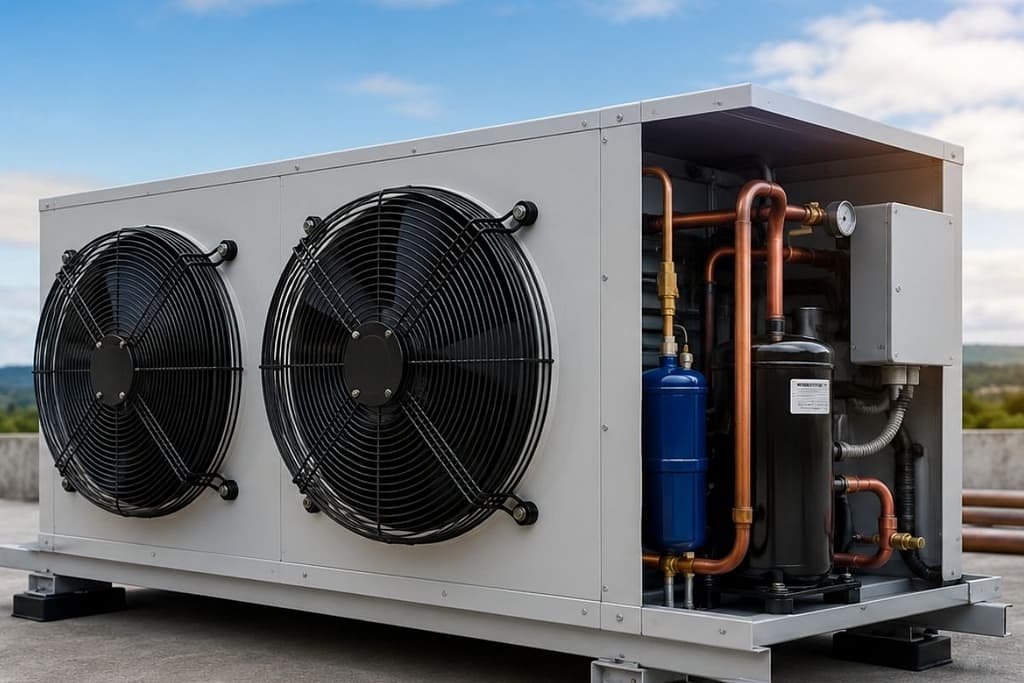
Quick Answer: An air-cooled condensing unit is a refrigeration assembly that uses ambient air to remove heat from refrigerant. It typically combines a compressor, air-cooled condenser, fan and controls.
Introduction
Refrigeration systems are an important part of India’s food processing, cold chain, dairy, pharmaceutical, hospitality and retail sectors. From cold rooms and frozen food stores to supermarkets and industrial refrigeration plants, reliable temperature control is essential for maintaining product quality and reducing spoilage.
One of the most widely used solutions in these applications is the Air-Cooled Condensing Unit. It is designed to reject the heat absorbed by the refrigeration system into the surrounding air. Unlike a water-cooled system, it does not require cooling water or a cooling tower for condenser heat rejection.
A typical condensing unit brings together major refrigeration components such as the compressor, condenser, condenser fan and associated safety and control devices. The evaporator remains at the cooling location, such as inside a cold room, while the condensing unit is generally installed outside or in a suitable machinery area. Danfoss describes the condensing unit as a combination that can include the compressor, condenser, receiver and associated electrical components.
For Indian businesses, selecting the right unit is particularly important because refrigeration equipment may need to operate during periods of high ambient temperature. Condenser size, airflow, compressor capacity, refrigerant, operating temperature and installation conditions can all influence performance.
What Is an Air Cooled Condensing Unit?
An air cooled condensing unit is a packaged refrigeration assembly in which the compressor circulates and compresses refrigerant, while a finned condenser and fan reject heat to the surrounding air.
The basic refrigeration cycle works as follows:
- The evaporator absorbs heat from the refrigerated space.
- Refrigerant leaves the evaporator as low-pressure vapour.
- The compressor draws in and compresses this vapour.
- Hot, high-pressure refrigerant travels to the condenser.
- The condenser transfers heat from the refrigerant to ambient air.
- The refrigerant condenses into a high-pressure liquid.
- The liquid travels towards the expansion device and evaporator.
- The cycle repeats.
In an air cooled condenser, heat transfer takes place between the refrigerant and moving ambient air. Forced airflow through the condenser coil is normally provided by one or more fans.
Main Components of an Air Cooled Condensing Unit
The exact configuration varies according to the manufacturer, capacity and application, but the major components generally include the following.
1. Compressor
The compressor is the driving component of the refrigeration cycle. It draws low-pressure refrigerant vapour from the suction line and compresses it to a higher pressure and temperature.
Depending on the application, condensing units may use scroll, reciprocating, semi-hermetic or other compressor technologies. Copeland, for example, offers scroll, semi-hermetic and hermetic condensing unit options for different refrigeration applications.
2. Air Cooled Condenser
The condenser removes heat from the high-pressure refrigerant. It commonly consists of tubes and fins through which ambient air is moved by condenser fans.
A properly sized condenser is particularly important in hot climates because the unit must reject heat even when outdoor temperatures are high.
3. Condenser Fan and Motor
The condenser fan moves air across the condenser coil. Adequate airflow helps maintain appropriate condensing conditions and supports efficient refrigeration operation.
Blocked coils, damaged fan blades or a faulty fan motor can restrict heat rejection and increase condensing pressure.
4. Liquid Receiver
Depending on the design, a liquid receiver stores refrigerant in the liquid state and helps manage variations in refrigerant charge during operation.
Not every condensing unit has exactly the same component configuration, so the manufacturer’s technical documentation should always be checked before installation or servicing.
5. Filter Drier
A filter drier helps remove moisture and contaminants from the refrigeration circuit. Danfoss identifies filter driers as system-protection components that help remove moisture, acids and contaminants.
6. Pressure and Safety Controls
Pressure switches, electronic controllers, overload protection and other safety devices may be incorporated to protect the compressor and refrigeration system.
These controls can help respond to abnormal operating conditions such as excessive discharge pressure or low suction pressure.
7. Electrical and Control Components
Depending on the model, the unit may include contactors, relays, control boards, terminal arrangements, fan controls and other electrical components.
Modern systems can also incorporate electronic diagnostics and variable fan control to improve monitoring and operating efficiency.
How Does an Air Cooled Condensing Unit Work?
The working principle is based on the vapour-compression refrigeration cycle.
Step 1: Heat Absorption
The evaporator absorbs heat from the cold room, freezer, display cabinet or other refrigerated space. The refrigerant evaporates at a low pressure and temperature.
Step 2: Compression
The compressor receives the refrigerant vapour and compresses it. Compression increases the refrigerant’s pressure and temperature.
Step 3: Heat Rejection
The hot refrigerant enters the air cooled condenser. The condenser fan pushes ambient air across the condenser surface.
Heat moves from the refrigerant to the surrounding air. As the refrigerant loses heat, it changes from vapour into liquid.
Step 4: Liquid Refrigerant Flow
The high-pressure liquid refrigerant moves towards the expansion device. The expansion device reduces its pressure before the refrigerant enters the evaporator.
Step 5: Cooling Cycle
The low-pressure refrigerant absorbs heat again inside the evaporator, and the cycle continues.
This arrangement makes the condensing unit the key heat-rejection and compression section of many remote refrigeration systems.
Applications of Air Cooled Condensing Units
Air cooled condensing units are used across a wide range of refrigeration applications.
Cold Rooms
Cold rooms for fruits, vegetables, dairy products, meat, seafood and other temperature-sensitive products commonly use condensing units connected to a suitable evaporator.
Food Processing
Food processing facilities require controlled temperatures at different stages of production, storage and distribution. Properly selected refrigeration equipment can help maintain the required product conditions.
Supermarkets and Retail Stores
Display cases, walk-in coolers, freezers and other retail refrigeration systems can use air cooled condensing technology.
Restaurants and Commercial Kitchens
Commercial kitchens need refrigeration for ingredients, prepared food and frozen products. Compact condensing units can be suitable for many such installations.
Dairy and Milk Chilling
Milk collection and processing facilities require dependable refrigeration. Air cooled systems can be used in suitable milk chilling and cold storage applications.
Pharmaceutical Storage
Temperature-sensitive pharmaceutical products may require controlled storage conditions. The refrigeration system must be selected according to the required temperature range, load and applicable standards.
Industrial Refrigeration
Larger refrigeration installations may require an Industrial Condensing Unit designed around higher cooling loads, specific refrigerants and demanding operating conditions.
Air Cooled Condensing Unit vs Water Cooled Condensing Unit
The primary difference is the medium used to reject heat.
An air cooled system transfers condenser heat directly to ambient air. A water cooled system uses water to carry heat away from the condenser.
Air Cooled Systems
Advantages:
- No cooling tower is normally required
- No condenser-water circulation system is required
- Generally simpler installation
- Lower water consumption
- Suitable for many remote refrigeration applications
- Easier installation in locations where water availability is limited
Limitations:
- Performance is affected by ambient temperature
- Condenser coils require regular cleaning
- Fan noise can be a consideration
- High outdoor temperatures can increase condensing pressure
For many Indian installations, avoiding dependence on condenser water can be a significant practical advantage. However, the equipment must still be properly selected for the site’s ambient conditions.
Key Benefits of Air Cooled Condensing Units
1. Water-Free Heat Rejection
The main advantage is that heat is rejected using air rather than condenser water. This can simplify the refrigeration plant and reduce water-related maintenance requirements.
2. Straightforward Installation
Packaged condensing units can reduce the complexity of assembling individual refrigeration components at the installation site.
3. Flexible Installation
Many units can be installed outdoors or in dedicated machinery spaces, depending on their construction and manufacturer specifications.
4. Easy Maintenance Access
A well-designed unit provides access to important components such as the compressor, condenser, electrical controls and service connections.
5. Wide Range of Applications
Units are available for different temperature ranges, capacities and compressor technologies. For example, Copeland’s India-market literature includes air-cooled condensing units as well as scroll and semi-hermetic options.
6. Suitable for Indian Climatic Conditions
Some units are specifically designed with larger condenser surfaces, higher airflow and construction suitable for elevated ambient temperatures. Copeland’s India-market air-cooled unit literature, for example, describes designs intended for elevated ambient conditions and operation at ambient temperatures up to 46°C for specified models.
However, this should not be interpreted as a universal operating limit. The permitted ambient temperature depends on the exact model and manufacturer.
Important Types of Condensing Units
Different refrigeration applications require different configurations.
Commercial Condensing Unit
A Commercial Condensing Unit is generally designed for applications such as shops, restaurants, supermarkets, display cases and walk-in refrigeration.
Outdoor Condensing Unit
An Outdoor Condensing Unit is designed for installation in an outdoor environment. Its housing, electrical components and other parts must be suitable for exposure to the relevant weather and operating conditions.
Scroll Compressor Condensing Unit
A Scroll Compressor Condensing Unit uses a scroll compressor and is commonly selected where compact size, reliability and efficient operation are important. Scroll-based condensing units are available for medium- and low-temperature refrigeration applications.
High-Temperature and Medium-Temperature Systems
These systems can be used for applications such as chilled storage, positive-temperature cold rooms and food retail refrigeration.
Low-Temperature Systems
A low-temperature evaporator paired with an appropriately selected condensing unit can be used for freezer and frozen-product applications. Low-temperature systems require careful compressor and refrigerant selection because operating conditions are significantly different from normal chilled storage.
How to Select the Right Air Cooled Condensing Unit
Choosing a unit only on the basis of compressor horsepower is not recommended. The complete refrigeration load and operating conditions should be evaluated.
1. Calculate the Refrigeration Load
Consider:
- Room dimensions
- Insulation thickness and quality
- Product entering temperature
- Product quantity
- Desired room temperature
- Door-opening frequency
- Ambient temperature
- Lighting and electrical equipment
- People working inside the room
- Defrost requirements
2. Identify the Required Temperature Range
A chilled room and a frozen storage room have different refrigeration requirements. The evaporating temperature and compressor operating range must match the application.
3. Consider Ambient Temperature
This is particularly important in India. A unit selected using mild design conditions may not perform as expected when installed in a region experiencing very high summer temperatures.
4. Match the Compressor and Refrigerant
The compressor, refrigerant, evaporator and expansion device need to work together as a properly designed system.
5. Check Condenser Capacity
The condenser should be capable of rejecting the required heat under the expected ambient conditions.
6. Consider Energy Efficiency
Look at compressor efficiency, fan power, controls, condenser design and the expected operating schedule rather than focusing only on the initial purchase price.
7. Check Service and Spare Parts Availability
For commercial and industrial refrigeration, downtime can be expensive. Before selecting equipment, check the availability of trained technicians, genuine components and after-sales support.
Role of a High Capacity Evaporator
A high-capacity evaporator may be required where the refrigeration load is substantial and a larger heat-transfer capacity is needed.
The evaporator and condensing unit should be selected as a matched system. Installing a large evaporator without correctly sizing the compressor, condenser and expansion device can result in poor system performance.
Maintenance Tips for Air Cooled Condensing Units
Regular preventive maintenance can help maintain refrigeration performance.
Clean the Condenser Coil
Dust, dirt and debris can restrict airflow and reduce heat transfer. This is especially relevant in dusty industrial environments and areas with high particulate exposure.
Inspect Condenser Fans
Check fan motors, blades, bearings and electrical connections for abnormal noise, vibration or overheating.
Check Refrigerant Circuit
Qualified refrigeration technicians should inspect for refrigerant leakage, abnormal pressures and other signs of system problems.
Inspect Electrical Components
Loose terminals, damaged wiring and overheating electrical components should be addressed promptly by qualified personnel.
Monitor Operating Conditions
Record important parameters such as suction pressure, discharge pressure, temperature and compressor current where appropriate. Comparing readings over time can help identify developing problems.
Maintain Adequate Airflow
Avoid installing the unit where walls, stored materials or other equipment block the condenser’s air intake or discharge.
Common Problems and Their Causes
High Condensing Pressure
Possible causes include:
- Dirty condenser coil
- Poor airflow
- Fan failure
- Excessive ambient temperature
- Incorrect refrigerant charge
- Obstructions around the condenser
Low Cooling Performance
Possible causes may include incorrect system sizing, inadequate refrigerant flow, evaporator problems, compressor issues, poor insulation or excessive heat load.
Compressor Overheating
High compression ratio, inadequate cooling, electrical problems, poor operating conditions or other system faults can contribute to compressor overheating.
Because refrigeration systems operate under pressure and involve electrical and refrigerant hazards, diagnosis and servicing should be performed by qualified refrigeration professionals.
Why Proper Sizing Matters
An oversized or undersized condensing unit can create operational and financial problems.
An undersized unit may struggle to reach the required temperature during peak load periods. This can increase running time and affect product storage conditions.
An oversized unit is not automatically better. Depending on the system design, it can result in inefficient cycling, higher initial cost and poor matching with the evaporator and controls.
The correct approach is to calculate the actual refrigeration requirement and select the condensing unit according to the manufacturer’s published performance data.
Frequently Asked Questions
What is an air cooled condensing unit?
An air cooled condensing unit is a refrigeration assembly that normally combines a compressor, air cooled condenser, fan and associated controls to compress refrigerant and reject heat to ambient air.
Where are air cooled condensing units used?
They are used in cold rooms, freezers, supermarkets, restaurants, food processing facilities, dairy applications, pharmaceutical storage and various commercial and industrial refrigeration systems.
Does an air cooled condensing unit require water?
No. The condenser rejects heat directly to ambient air, so a condenser-water circuit is not normally required.
Is an air cooled condensing unit suitable for India?
Yes, air cooled condensing units are widely applicable in India. However, the selected model must be rated for the expected ambient temperature and operating conditions. High ambient conditions can significantly affect condensing performance.
What is the difference between an air cooled condenser and a condensing unit?
An air cooled condenser is the heat-rejection component. A condensing unit is a larger assembly that typically includes the compressor, condenser, fan and other refrigeration components.
How do I select an air cooled condensing unit?
Start with the refrigeration load, required room temperature, evaporating temperature, refrigerant, ambient temperature, compressor capacity and condenser performance. Manufacturer performance tables should then be used to select the appropriate model.
How often should the condenser be cleaned?
There is no single interval suitable for every installation. Cleaning frequency depends on the environment. Dusty industrial sites may require more frequent inspection and cleaning than relatively clean commercial locations.
Can an air cooled condensing unit be installed outdoors?
Yes, where the specific unit is designed and approved for outdoor installation. Outdoor models normally include construction and protection appropriate for environmental exposure. Always follow the manufacturer’s installation requirements.
Conclusion
An Air Cooled Condensing Unit is a practical and widely used solution for refrigeration applications where reliable heat rejection, straightforward installation and reduced dependence on water are important. It can serve applications ranging from commercial cold rooms and food retail to dairy, food processing and industrial refrigeration.
However, good performance depends on more than selecting a compressor of the desired horsepower. Refrigeration load, ambient temperature, evaporating temperature, refrigerant, condenser capacity, airflow, controls and serviceability all need to be considered.
For Indian conditions, special attention should be given to high summer ambient temperatures, condenser cleanliness, airflow and local service support. A properly matched condensing unit and evaporator can improve reliability, maintain the required storage temperature and support efficient long-term refrigeration operation.
For any installation, final equipment selection, refrigerant choice, safety controls and commissioning should be based on the manufacturer’s technical data and carried out by qualified refrigeration professionals. Manufacturer documentation should take precedence over generic selection rules because operating limits and component configurations vary between models.