
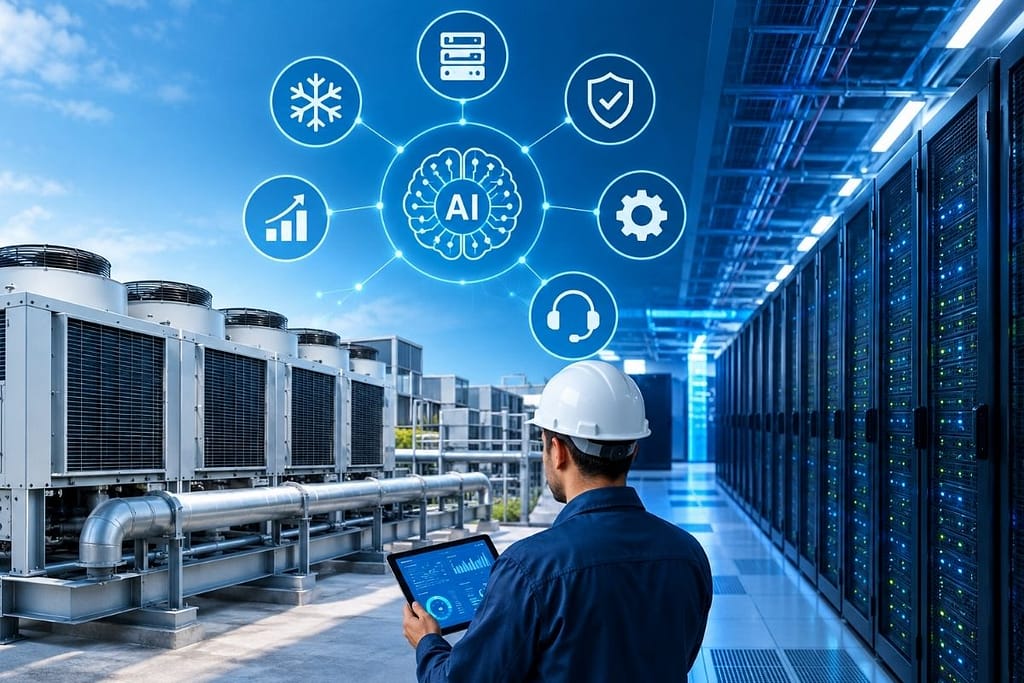
Reliable AI data centres require more than high cooling capacity. They depend on intelligent thermal management, efficient refrigeration equipment, continuous monitoring, preventive maintenance and expert technical services to maintain stable operating conditions, protect critical hardware and support uninterrupted computing performance.
Introduction
Artificial intelligence is transforming industries through machine learning, generative AI, high-performance computing and large-scale data processing. Behind these technologies are AI data centres that house powerful servers, GPUs, networking equipment and storage systems. However, these high-performance systems generate substantial heat, making effective cooling essential for reliable operations.
The focus is shifting from cooling capacity to system intelligence: the critical role of services in reliable AI data centres. While selecting appropriately sized cooling equipment remains important, long-term reliability also depends on system design, intelligent controls, energy efficiency, maintenance and technical support.
For HVAC and refrigeration specialists, this shift creates opportunities to deliver solutions that go beyond equipment supply and address the complete thermal management lifecycle.
1. Why Cooling Capacity Matters in AI Data Centres
AI workloads can place significantly higher thermal demands on data centre infrastructure than many conventional computing applications. High-density GPU racks, intensive processing tasks and continuously running servers can create concentrated heat loads that conventional cooling arrangements may struggle to manage.
Cooling capacity must therefore be matched to the facility’s actual requirements. Engineers need to consider server density, rack configuration, room layout, airflow patterns, ambient temperatures, redundancy requirements and expected future expansion.
An undersized system may struggle to maintain suitable operating temperatures during peak workloads. An oversized or poorly controlled system, meanwhile, may consume unnecessary energy and increase operating costs.
Effective cooling design should address three key objectives:
- Thermal stability: Maintaining suitable operating conditions for sensitive IT equipment.
- Energy efficiency: Delivering the required cooling without unnecessary power consumption.
- Scalability: Supporting additional computing capacity as AI workloads grow.
Cooling capacity establishes the foundation, but intelligent operation and ongoing services help maintain performance over time.
2. From Traditional Cooling to Intelligent Thermal Management
Modern AI data centres need cooling systems that can respond to changing workloads and environmental conditions. Instead of operating at fixed settings regardless of demand, intelligent thermal management uses sensors, controllers and monitoring platforms to support informed adjustments.
Depending on the installation, these systems can monitor temperatures, humidity, pressure, equipment status and energy consumption. Data from these measurements helps operators identify abnormal conditions, detect developing faults and optimise cooling performance.
Intelligent control strategies can also coordinate fans, compressors, pumps and other equipment to match cooling output with changing thermal loads.
However, automation alone does not guarantee reliability. Sensors must be calibrated, control sequences must be configured correctly, alarms must be meaningful, and operating data must be interpreted by qualified personnel.
This is where professional services become essential. Skilled HVAC specialists can help integrate equipment, commission controls, evaluate performance and maintain the system throughout its operating life.
3. The Importance of Refrigeration Equipment and System Components
Reliable thermal management depends on the performance of individual components as well as the way they work together. Understanding the components of air conditioning system design is particularly important when developing cooling solutions for demanding industrial and data centre environments.
Key components may include:
- Compressors: Circulate refrigerant and support the refrigeration cycle.
- Evaporators or cooling coils: Absorb heat from the air or another cooling medium.
- Condensers: Reject heat to the surrounding environment or a designated heat-rejection system.
- Expansion devices: Regulate refrigerant flow and pressure.
- Fans and pumps: Move air or fluid through the cooling system.
- Sensors and controllers: Measure operating conditions and help regulate equipment performance.
An Air Cooled Condensing Unit can be an important part of a suitable refrigeration or cooling arrangement, depending on the system design, required capacity and environmental conditions. It combines key refrigeration functions to reject heat to outdoor air.
For data centre applications, equipment selection must account for operating temperatures, efficiency, maintenance access, redundancy and compatibility with the wider cooling architecture. Not every conventional refrigeration product is suitable for direct data centre cooling, so engineering assessment is essential.
4. Why Technical Services Are Critical to Reliability
Even a well-designed cooling system can underperform if it is incorrectly installed, poorly commissioned or inadequately maintained. Technical services help bridge the gap between equipment specifications and real-world operating performance.
Installation and Commissioning
Professional installation ensures that equipment, electrical connections, refrigerant circuits, sensors and control systems are configured according to design requirements. Commissioning verifies that the system operates as intended before it enters service.
Preventive Maintenance
Routine inspections can identify dirty coils, restricted airflow, refrigerant-related issues, worn components, sensor errors and unusual operating conditions. Addressing these issues early can reduce the risk of unexpected downtime.
Fault Diagnosis and Corrective Support
When a cooling system develops a fault, a timely and systematic response is essential. Technical teams can analyse alarms, review operating data, identify root causes and restore equipment operation safely.
Performance Optimisation
Cooling performance can change as server loads, outdoor temperatures and facility requirements evolve. Periodic assessments help identify opportunities to improve control settings, reduce energy waste and maintain appropriate thermal conditions.
These services should be supported by documented maintenance schedules, equipment histories, escalation procedures and clear responsibilities.
5. Predictive Maintenance and System Intelligence
Predictive maintenance uses operating data to identify signs of developing equipment problems before they cause a major failure. Depending on the available monitoring infrastructure, useful indicators may include rising compressor temperatures, unusual pressure variations, increasing fan vibration or declining heat-transfer performance.
For example, a gradual increase in operating temperature may indicate restricted airflow, coil fouling or another developing issue. Investigating the cause early can help prevent the problem from escalating.
Predictive maintenance does not eliminate every failure, and its effectiveness depends on reliable data, appropriate analytics and qualified technical interpretation. Nevertheless, it can complement scheduled preventive maintenance and help prioritise service activities.
In mission-critical environments, these capabilities can improve fault visibility, support maintenance planning and strengthen operational resilience.
6. How Pragya Refrigeration Fits into the HVAC and Refrigeration Ecosystem
Pragya Refrigeration operates in the HVAC and refrigeration equipment sector, providing products such as evaporators, condensing units, heat exchangers and control panels for commercial and industrial applications.
For businesses planning cooling infrastructure, working with an experienced Air Cooler Unit Manufacturer or refrigeration equipment supplier can help with equipment selection and application-specific requirements. The correct solution depends on the thermal load, installation environment, operating conditions and intended use.
Pragya Refrigeration can be considered as a potential equipment partner for relevant industrial refrigeration and heat-transfer requirements. For AI data centre projects, however, product suitability should be confirmed against the facility’s technical specifications, redundancy strategy, control requirements and applicable performance standards.
Equipment supply should form part of a broader engineering approach that includes system design, installation, commissioning, monitoring and maintenance. Collaboration between facility operators, data centre engineers and HVAC specialists is essential to achieving dependable performance.
7. Building a More Reliable AI Data Centre Cooling Strategy
Organisations planning or upgrading AI data centres should assess cooling infrastructure as a complete operational system rather than a collection of individual products.
A practical strategy includes:
- Assess the heat load: Evaluate current and projected server densities and workloads.
- Choose appropriate equipment: Match cooling capacity and operating characteristics to the design requirements.
- Plan for redundancy: Assess how the facility will maintain cooling during equipment failures or scheduled maintenance.
- Integrate monitoring: Establish clear visibility into temperatures, alarms, energy use and equipment status.
- Schedule maintenance: Define inspection intervals, service responsibilities and emergency response procedures.
- Review performance regularly: Use operational data to identify inefficiencies and emerging risks.
This approach supports informed decisions across the equipment lifecycle and helps organisations balance reliability, energy consumption and future scalability.
Conclusion
The future of AI data centre cooling depends on more than increasing cooling capacity. Intelligent controls, suitable refrigeration equipment, professional commissioning, predictive maintenance and responsive technical services all contribute to reliable thermal management.
The transition from cooling capacity to system intelligence reflects a broader change in how organisations manage critical infrastructure. Cooling equipment provides the necessary thermal performance, while engineering expertise and ongoing services help maintain that performance under changing conditions.
For industrial HVAC and refrigeration requirements, Pragya Refrigeration can be explored as a potential equipment partner, subject to application-specific evaluation. Ultimately, reliable AI data centres require a coordinated strategy in which equipment, monitoring, maintenance and technical expertise work together.
Frequently Asked Questions
Why is cooling important in AI data centres?
AI servers and GPUs generate substantial heat during intensive computing tasks. Effective cooling helps maintain suitable operating conditions, reduce thermal risks and support reliable equipment performance.
What is the role of system intelligence in data centre cooling?
System intelligence uses sensors, monitoring, controls and operational data to help regulate cooling output, detect abnormal conditions and improve maintenance decisions.
Which components of an air conditioning system support thermal management?
Common components include compressors, evaporators, condensers, expansion devices, fans, pumps, sensors and controllers. The exact configuration depends on the cooling architecture.
What is an air-cooled condensing unit?
An air-cooled condensing unit is refrigeration equipment that rejects heat from refrigerant to outdoor air. Its suitability depends on the cooling application, capacity requirements and system design.
How does preventive maintenance improve cooling reliability?
Preventive maintenance helps identify issues such as restricted airflow, dirty coils, worn components and control faults before they lead to more serious operational problems.
Can conventional industrial refrigeration equipment be used in AI data centres?
Potentially, depending on the application. Equipment must be evaluated for capacity, efficiency, operating conditions, control compatibility, redundancy and integration with the overall data centre cooling system.