
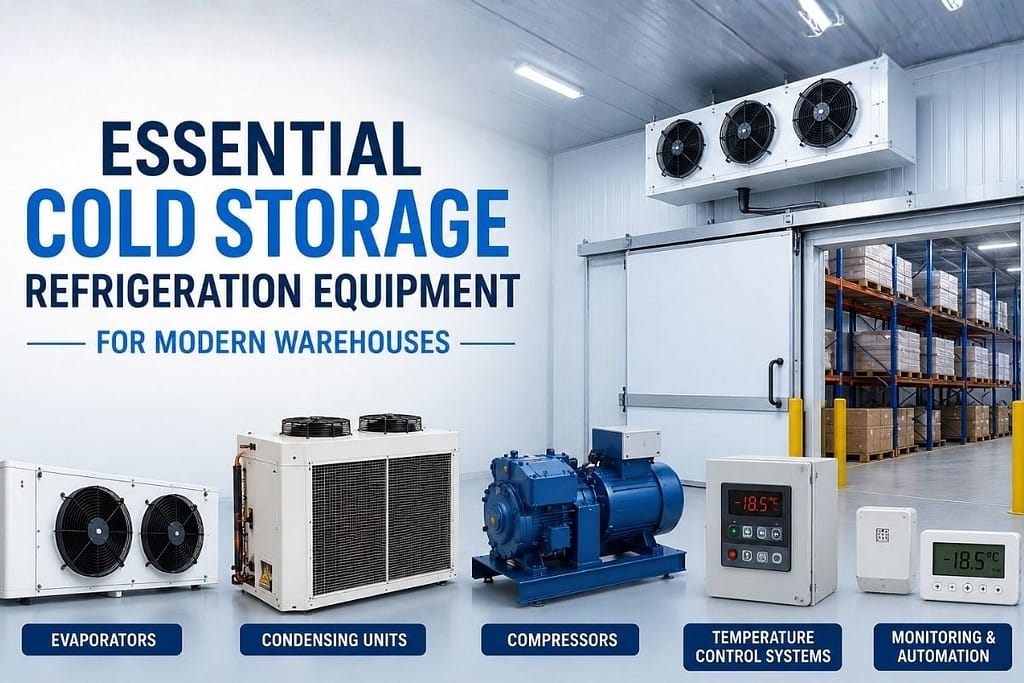
Essential Cold Storage Refrigeration Equipment for Modern Warehouses
Quick Answer: Modern cold storage warehouses require reliable refrigeration equipment, including compressors, condensing units, evaporators, controls, and monitoring systems, to maintain precise temperatures, protect products and improve energy efficiency. Introduction Cold storage warehouses play an essential role in India’s food supply chain, pharmaceutical industry, dairy sector, agriculture, seafood exports and other temperature-sensitive businesses. From storing fresh fruits and vegetables to preserving vaccines, frozen foods and dairy products, these facilities depend on reliable refrigeration systems to maintain the required temperature and product quality. However, a cold storage facility is much more than an insulated room with cooling equipment. Its performance depends on selecting the right refrigeration equipment according to the storage capacity, product type, operating temperature, warehouse design and local environmental conditions. For example, a cold room storing fresh produce may operate between 0°C and 10°C, while a frozen food warehouse may need temperatures of -18°C or below. Each application requires a carefully designed refrigeration system capable of delivering consistent cooling without excessive energy consumption. This article explains the essential cold storage refrigeration equipment used in modern warehouses, their functions, applications and the factors businesses in India should consider when selecting a suitable system. Key Points 1. Compressors: The Heart of the Refrigeration System The compressor is one of the most important components in a cold storage refrigeration system. Its primary function is to compress the refrigerant vapour and circulate it through the refrigeration cycle. In simple terms, the compressor helps move heat from inside the cold storage facility to the outside environment. Different types of compressors may be used depending on the refrigeration capacity and application. These include: Smaller commercial cold rooms may use scroll or reciprocating compressors, while larger warehouses and industrial refrigeration facilities may require screw compressor systems. When selecting a compressor, businesses should consider the required cooling capacity, operating temperature, refrigerant compatibility, energy consumption and maintenance requirements. A properly sized compressor is essential. An undersized unit may struggle to maintain the desired temperature, while an oversized system can result in unnecessary energy consumption and frequent compressor cycling. 2. Condensing Units: Removing Heat Efficiently A condensing unit is responsible for rejecting the heat absorbed from the cold storage area. It generally combines important components such as the compressor, condenser coil and associated controls. For small and medium-sized cold rooms, a Commercial Condensing Unit can provide an integrated and practical refrigeration solution. These systems are commonly used in applications such as restaurants, food storage facilities, dairy units and smaller warehouses. Larger facilities may require an Industrial Condensing Unit designed to handle higher refrigeration loads and continuous operation. Industrial systems are particularly suitable for large cold storage warehouses, food processing plants, seafood facilities and distribution centres. The location of the equipment is also important. An Outdoor Condensing Unit is installed outside the cold storage building, allowing heat generated during the refrigeration process to be released into the surrounding environment. In India, ambient temperatures can become extremely high during summer, especially in industrial areas and northern, central and western regions. Therefore, condensing units should be selected with local climatic conditions in mind. Poor ventilation around outdoor equipment can reduce efficiency and increase energy consumption. 3. Evaporators: Delivering Cooling Inside the Cold Room While the condensing system removes heat from the refrigeration cycle, the evaporator is responsible for absorbing heat from inside the cold storage space. The evaporator coil contains refrigerant that absorbs heat from the surrounding air. Fans circulate the cooled air throughout the warehouse or cold room, helping maintain the required temperature. For large warehouses with significant cooling requirements, a High Capacity Evaporator can provide the necessary cooling performance and air circulation. Such equipment is particularly important in facilities where large quantities of products are stored or where frequent loading and unloading introduce additional heat into the facility. Air distribution should be considered carefully during system design. Uneven airflow can create temperature variations within the warehouse, resulting in warmer and colder zones. The evaporator should therefore be selected according to factors such as: Correct placement of evaporators can help ensure more uniform temperature distribution throughout the facility. 4. Low-Temperature Refrigeration Equipment for Frozen Storage Frozen food warehouses require specialised refrigeration equipment capable of operating efficiently at significantly lower temperatures. A low-temperature evaporator is designed for applications that require sub-zero storage conditions. These systems may be used for frozen meat, seafood, ice cream, ready-to-eat frozen products and other goods requiring low-temperature preservation. Low-temperature applications present additional challenges because frost can accumulate on evaporator coils. Defrost systems are therefore an important part of the overall refrigeration design. Common defrost methods include: The appropriate defrost system depends on the application, equipment design and operating conditions. Poorly managed frost can reduce heat transfer, restrict airflow and increase energy consumption. Regular maintenance and correct defrost scheduling are therefore essential. 5. Scroll Compressor Condensing Units for Efficient Applications A Scroll Compressor Condensing Unit is commonly selected for commercial and medium-capacity refrigeration applications because of its compact design and relatively efficient operation. Scroll compressors use two spiral-shaped components to compress refrigerant. Their design can provide smooth operation and fewer moving parts compared with some traditional compressor designs. These systems may be suitable for applications such as: The suitability of any refrigeration system should always be based on the actual cooling load calculation rather than simply choosing equipment according to room dimensions. 6. Refrigeration Controls and Automation Systems Modern cold storage facilities increasingly depend on automation and digital monitoring systems. Temperature controllers, sensors and programmable systems allow operators to monitor critical conditions and make adjustments when required. Important monitoring parameters may include: Automated monitoring can help warehouse operators identify temperature deviations before they result in significant product losses. For businesses storing pharmaceuticals, vaccines or other high-value temperature-sensitive products, continuous temperature monitoring and data recording may also be important for quality management and regulatory compliance. Remote monitoring systems can further allow facility managers to review refrigeration performance without being physically present at the warehouse. 7. Insulated Panels and Cold Room Infrastructure Refrigeration equipment cannot operate efficiently without proper
