
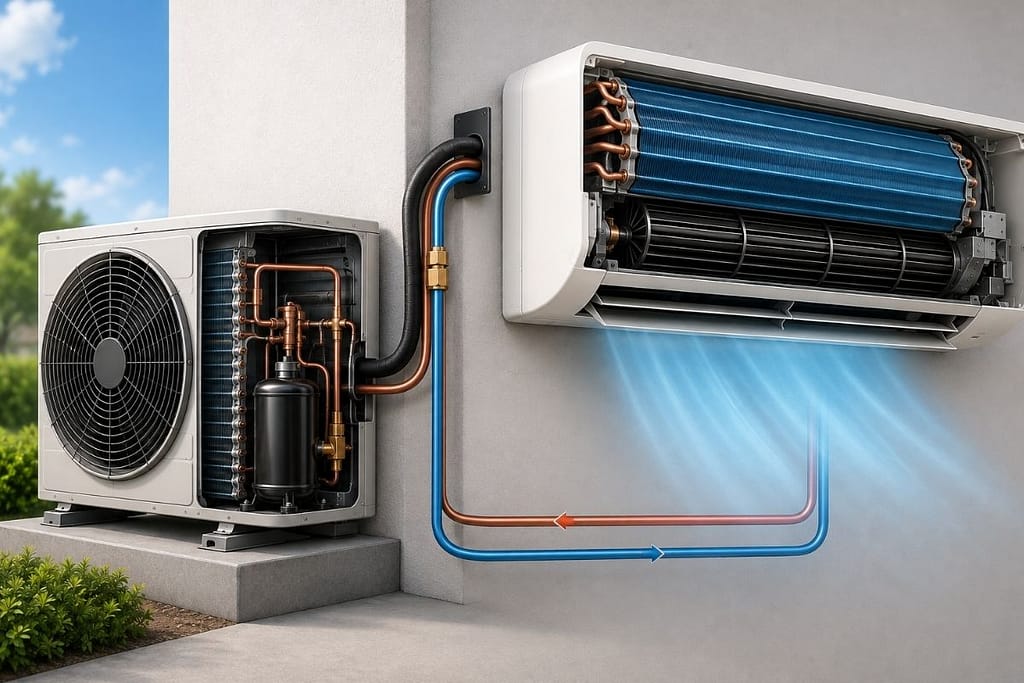
Components of an Air Conditioning System: A Complete Guide to the Main Parts and Their Functions
An air conditioning system combines mechanical, electrical and air-handling parts that pull heat out of an indoor space and push it outside. A residential split unit and a large commercial HVAC system rely on the same basic refrigeration principle, even though they look nothing alike. Homeowners get value from knowing these components. So do technicians, facility managers, engineering students, and anyone running an HVAC business. If you know how a part works, you can read cooling performance, catch problems early, and plan maintenance before something breaks. Pragya Refrigeration builds HVAC and refrigeration solutions for industrial and commercial applications. Get the selection or the running condition of an evaporator, coil, or condensing unit wrong, and cooling efficiency and system reliability both take the hit. Four major components form the core of a conventional vapour-compression air conditioning system: the compressor, condenser, expansion device and evaporator. Refrigerant moves through these parts, picking up heat from the indoor environment and dumping it outdoors. 5 Key Units of an Air Conditioning System Here are the five key units that form the foundation of a typical air conditioning system, before we get into the details of each: These parts don’t cool a room on their own. Together, running as one continuous cycle, they do. 1. Compressor Technicians call the compressor the heart of the system, and that’s not marketing talk. It’s the thing that drives refrigerant around the entire circuit. Refrigerant leaves the evaporator as a low-pressure vapour once it’s absorbed heat. The compressor pulls that vapour in and squeezes it. That squeeze raises both pressure and temperature, so what comes out the other side is a high-pressure, high-temperature vapour headed for the condenser. The compressor also builds the pressure difference that keeps everything moving through the system in the first place. Common types of compressors AC systems don’t all use the same compressor design. You’ll find: Reciprocating compressors, rotary compressors, scroll compressors Screw compressors, centrifugal compressors Small residential units usually run rotary or scroll compressors. Larger commercial and industrial jobs call for scroll, screw or centrifugal designs, depending on the cooling capacity and the application. 2. Condenser The condenser’s job is to get rid of the heat the refrigerant is carrying. High-pressure, high-temperature vapour leaves the compressor and enters the condenser. Air or water pulls heat off the refrigerant here. Once enough heat leaves, the refrigerant flips from vapour to high-pressure liquid. In a typical split AC, the condenser is housed in the Outdoor Condensing Unit. That’s why it needs room to breathe and unobstructed airflow around it. Tubes and fins inside the condenser give it a large surface for heat transfer, and an outdoor fan pushes air across the coil to help that heat leave faster. Why condenser airflow matters Dirt, debris, or a bad installation choking airflow across the condenser means the system can’t reject heat properly. Pressure climbs, efficiency drops, and the compressor ends up working harder than it should. A clean outdoor unit with the clearance the manufacturer recommends goes a long way toward keeping the system reliable. 3. Expansion Device The expansion device does two jobs: it controls how much refrigerant flows through, and it drops the pressure before that refrigerant reaches the evaporator. Refrigerant coming out of the condenser is a high-pressure liquid. Push it through the expansion dev,ice and the pressure falls. That drop is what lets the refrigerant absorb heat once it hits the evaporator. Common expansion devices include: Capillary tubes, thermostatic expansion valves (TXVs), electronic expansion valves (EEVs), fixed-orifice devices in certain systems Smaller units often stick with fixed metering. Bigger or more sophisticated systems tend to use thermostatic or electronic expansion valves instead. Get the flow wrong here and cooling suffers. Too much refrigerant reaching the evaporator, or too little, throws off both performance and operation. 4. Evaporator This is where the actual cooling happens. Refrigerant leaves the expansion device at a lower pressure and enters the evaporator. As it evaporates, it soaks up heat from the indoor air around it. An indoor blower moves warm room air across that cold coil. The refrigerant grabs the heat out of the air, and the blower sends the now-cooled air back into the room. There’s a second job the evaporator quietly handles: dehumidifying. Warm, humid air hits the cold coil surface, moisture condenses out of it, and that water drains away through the condensate system. 5. Refrigerant Refrigerant is the fluid doing the actual work of moving heat through the system. As it circulates through the circuit, its pressure and temperature keep changing. Depending on where it sits in the cycle, it can be liquid, vapour, or a mix of both. At the evaporator, it absorbs heat. At the condenser, it lets that heat go. Which refrigerant a system uses depends on the equipment design, the capacity, efficiency targets, and current environmental regulations. R-32 and R-410A show up in a lot of modern systems, while older equipment may still run refrigerants that regulators have restricted or phased down over environmental concerns. Stick to whatever refrigerant the manufacturer specifies. Charge it wrong, or mix incompatible refrigerants, and both performance and reliability suffer. 6. Evaporator and Condenser Coils Both coils are heat-transfer components, and the whole system leans on them working properly. The evaporator coil pulls heat out of indoor air. The condenser coil pushes heat from the refrigerant into outdoor air. Same job, opposite direction. Coils typically use copper tubing, aluminium tubing, and aluminium fins, and the fins are there to add surface area so heat transfer happens faster. Coil design isn’t an afterthought in commercial and industrial HVAC. Dimensions, tube arrangement, fin design, airflow, and operating temperature all shape how well a coil actually transfers heat. Clean the coils regularly. Dust and dirt build up, airflow suffers, and heat-transfer efficiency goes with it. In specialised refrigeration applications, a Low Temperature Evaporator is designed to operate under the lower-temperature conditions required for applications such as cold rooms and frozen storage. 7. Indoor Fan or Blower The blower’s
