
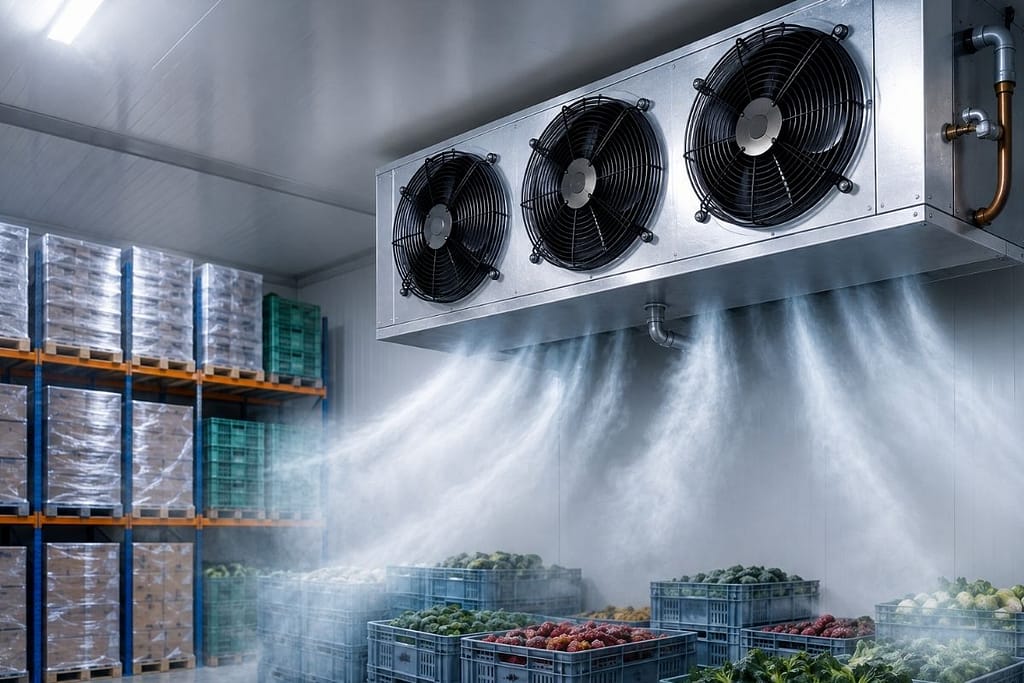
How Does a Blast Freezer Evaporator Work in Cold Storage Systems?
Quick Answer: A blast freezer evaporator absorbs heat from food by circulating low-temperature refrigerant through finned coils while powerful fans push cold air across the product at high velocity, freezing it rapidly and preserving texture, weight, and quality. Introduction Anyone who has worked in India’s cold chain, whether running a small fish-processing unit in Kochi or managing a large frozen-food plant near Delhi, knows that the evaporator is the real workhorse of a blast freezer. The compressor and condenser get most of the attention because they sit outside and look impressive, but the evaporator is the component actually doing the job of pulling heat out of the product. Get the evaporator design wrong, and even the best compressor in the world will not stop your prawns or parathas from freezing unevenly. This article breaks down exactly how a blast freezer evaporator functions, why it behaves differently from a normal cold room evaporator, and what to check if yours is not performing as it should. It is written for plant engineers, cold storage owners, food processors, and students of refrigeration who want a clear, accurate picture rather than marketing copy. Key Takeaways The Basic Refrigeration Loop Behind Every Evaporator Before looking at the blast freezer specifically, it helps to remember where the evaporator sits in the wider refrigeration cycle. Refrigerant leaves the condenser as a high-pressure liquid, passes through an expansion device such as a thermostatic expansion valve or an electronic expansion valve, and enters the evaporator coil at low pressure and low temperature. Because the pressure has dropped, the refrigerant’s boiling point drops with it, often to somewhere between minus 35°C and minus 45°C in a blast freezer, compared to around minus 8°C to minus 5°C in a typical chiller. At this low temperature, the liquid refrigerant is colder than the air being blown across the coil. Heat naturally moves from warm to cold, so the air gives up its heat to the refrigerant, which boils and turns to vapour inside the tubes. That vapour is then drawn back to the compressor, and the cycle repeats. This is standard refrigeration theory, but what makes a blast freezer evaporator distinct is how aggressively this heat exchange is pushed. What Actually Happens Inside a Blast Freezer Evaporator 1. Refrigerant Distribution Across the Coil The coil itself is built from multiple parallel circuits of copper or aluminium tubing, each fitted with thin aluminium fins to increase surface area. A distributor at the coil inlet splits the incoming refrigerant evenly across these circuits. If distribution is uneven, some circuits starve of refrigerant while others flood, and the result is patchy freezing across the product load, something operators often notice as some trays freezing faster than others in the same batch. 2. Boiling and Heat Absorption As refrigerant travels through the tubes, it absorbs heat and gradually changes from liquid to vapour. This phase change is far more efficient at absorbing heat than simply warming a liquid or a gas would be, which is why refrigeration systems rely on evaporation rather than sensible heat alone. By the time the refrigerant reaches the coil outlet, it should be fully vaporised with a small amount of superheat, typically 4°C to 8°C, confirming that no liquid refrigerant is returning to the compressor, which would otherwise cause serious mechanical damage. 3. High-Velocity Air Movement This is the step that separates a blast freezer from a standard cold room. Large axial fans, usually mounted directly behind or above the evaporator coil, draw warm air from the product and force it through the coil fins at speed. The combination of a very cold coil surface and fast-moving air creates an intense rate of heat transfer, which is why a batch of chicken portions that might take 24 hours to freeze in a still-air cold room can freeze in 3 to 6 hours inside a blast freezer tunnel. Fast freezing matters for a practical reason beyond speed. When food freezes slowly, large ice crystals form inside the cells and rupture their walls, so the product loses moisture and texture on thawing. Rapid freezing produces small, uniform ice crystals that cause far less cellular damage, which is exactly why blast freezing is preferred for high-value products like seafood, meat, and ready-to-eat meals across Indian export units. 4. Frost Formation and Defrost Cycles Because the coil surface runs well below 0°C, moisture in the air condenses and freezes onto the fins almost continuously. This frost layer acts as insulation, reducing airflow and heat transfer the longer it is left unchecked. Most blast freezer evaporators, therefore, run scheduled defrost cycles, commonly electric heater defrost, hot gas defrost, or water defrost, timed by hours of compressor run rather than a fixed clock. In Indian coastal and monsoon regions, where ambient humidity is consistently high, defrost intervals often need to be shorter than the manufacturer’s default setting to keep the coil performing at its rated capacity. 5. Return Air and Repeat Once air has passed through the coil and dropped in temperature, it is directed back over the product, typically through a tunnel or spiral arrangement, and the cycle repeats continuously until the product core reaches the target temperature, usually minus 18°C or lower for long-term frozen storage. Why This Design Matters for Indian Cold Storage Operators India’s cold chain covers a huge range of climates, from the dry heat of Rajasthan to the humid coastline of Andhra Pradesh and Kerala. Ambient conditions directly affect condenser performance and, by extension, how hard the evaporator has to work. A poorly maintained condenser raises head pressure, which reduces the pressure drop available at the expansion valve and can starve the evaporator of refrigerant even when the compressor is running fine. This is a common reason operators report “the blast freezer is not freezing as fast as before” despite no obvious fault with the evaporator coil itself. Regular fin cleaning, correct refrigerant charge, properly calibrated superheat, and a defrost schedule matched to local humidity are the practical levers that