
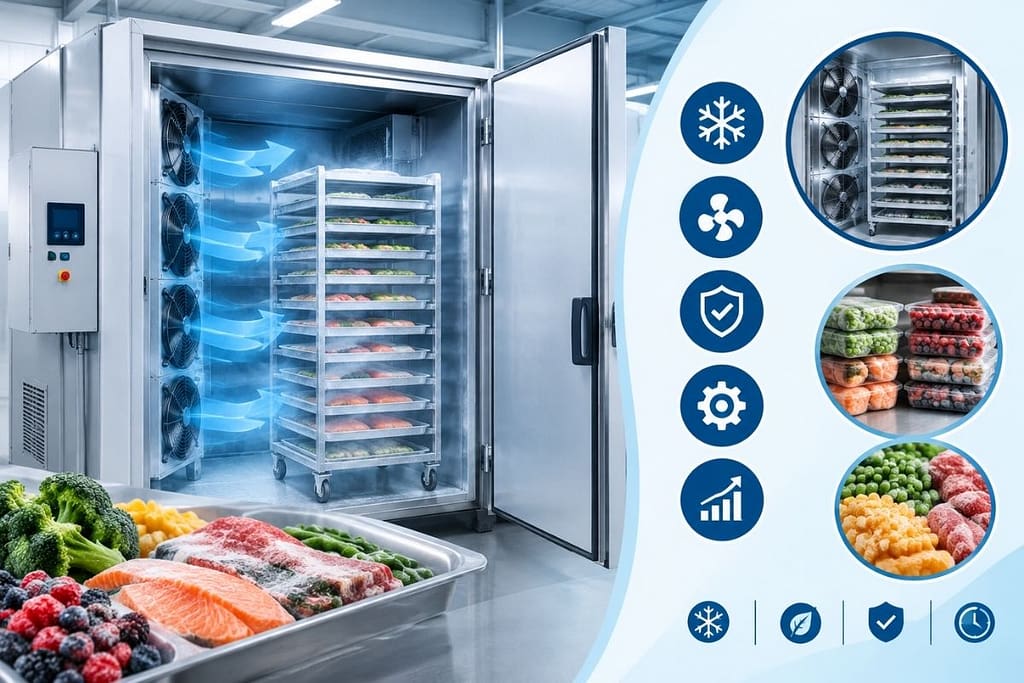
Quick Answer: An air blast freezer is an industrial refrigeration system that rapidly freezes food by circulating very cold air at high speed, helping preserve product quality, texture and shelf life.
Introduction
Freezing is an essential process in India’s food processing and cold chain industries. From seafood and meat to frozen vegetables, dairy products and ready-to-eat meals, many food products require rapid and controlled freezing to maintain their quality during storage and transportation. An air blast freezer is one of the most widely used refrigeration systems for this purpose.
Unlike a conventional freezer that mainly maintains the temperature of already-frozen products, an air blast freezer is designed to remove heat from fresh or chilled products quickly. It uses powerful fans to circulate cold air over the food, allowing the temperature to decrease rapidly and uniformly when the system is correctly designed and operated.
Air blast freezers are commonly used in seafood processing units, meat processing plants, commercial kitchens, bakeries, food manufacturing facilities and industrial cold storage systems. Understanding their working principle, components, benefits and applications helps businesses select suitable freezing equipment for their operational requirements.
5 Key Takeaways
- Rapid freezing: An air blast freezer uses high-velocity cold air to remove heat from products faster than conventional still-air freezing.
- Food quality preservation: Faster freezing generally creates smaller ice crystals, helping retain the texture and quality of many food products.
- Industrial applications: It is suitable for seafood, meat, poultry, vegetables, bakery items and prepared foods.
- Essential components: The system includes an insulated chamber, refrigeration unit, evaporator, fans, controls and a defrost arrangement.
- Correct system selection: Freezing performance depends on product size, loading pattern, airflow, refrigeration capacity and the required final core temperature.
What Is an Air Blast Freezer?
An air blast freezer is a specialised refrigeration machine that freezes products by exposing them to a continuous flow of very cold air moving at high speed. The cold air absorbs heat from the product, while the refrigeration system removes that heat from the chamber.
Industrial air blast freezers commonly operate with chamber air temperatures around −30°C to −40°C, although the actual operating temperature varies according to the product, equipment design and freezing requirements. The aim is to bring the product’s core temperature down to the specified frozen-storage temperature, often −18°C or lower for many frozen foods.
The equipment is available in different configurations, including batch freezers, trolley-based systems, freezing tunnels and continuous conveyor systems. Businesses can select a suitable model according to their daily production volume, available space and the type of products being processed.
It is important to distinguish between freezing and frozen storage. An air blast freezer removes heat rapidly to freeze a product, whereas a conventional cold room or storage freezer is generally designed to maintain products that have already been frozen.
How Does an Air Blast Freezer Work?
An air blast freezer works on the principle of forced convection heat transfer. Instead of allowing air to remain still around the product, powerful fans continuously move refrigerated air across its surface.
The process involves the following stages.
1. Loading the Products
Fresh, chilled or appropriately prepared products are placed on trays, racks, trolleys or conveyor belts. The products should be arranged to allow sufficient air circulation around them.
Overloading the chamber or placing packages too close together can obstruct airflow and increase freezing time.
2. Cooling the Air
The refrigeration system circulates refrigerant through an evaporator coil. As the refrigerant absorbs heat from the air passing over the coil, the air temperature decreases.
The evaporator is therefore one of the most important components in the system because its heat-transfer capacity directly influences freezing performance.
3. Circulating Cold Air at High Speed
Powerful fans distribute the cold air across the products. This forced circulation improves heat transfer between the food surface and the surrounding air.
The warmed air returns to the evaporator, where heat is removed before the air is circulated again. This continuous process helps lower the temperature of the products.
4. Freezing the Product Core
As heat moves from the product to the cold air, the water present in the food gradually freezes. Rapid passage through the main ice-crystal formation range generally produces smaller ice crystals than slower freezing.
Smaller ice crystals can help reduce damage to food structure and improve texture after thawing. However, the final result also depends on the food type, its composition, packaging and freezing conditions.
5. Monitoring the Final Temperature
The freezing cycle continues until the product reaches its specified core temperature. This is generally checked using a suitable temperature probe or validated monitoring system.
The required freezing time can vary considerably. Small food portions may freeze much faster than large meat cuts, thick seafood blocks or densely packed cartons. Therefore, a fixed cycle time should not be assumed suitable for every product.
After freezing, products are transferred to an appropriate frozen-storage facility, where the required temperature is maintained throughout storage and distribution.
Main Components of an Air Blast Freezer
An air blast freezer combines several refrigeration and air-handling components to achieve rapid, controlled freezing.
1. Insulated Freezing Chamber
The chamber contains the products during freezing. Its insulated walls, ceiling, floor and door help minimise heat gain from the surrounding environment.
High-quality insulation and properly sealed doors are particularly important in Indian commercial and industrial facilities, where ambient temperatures can be high.
2. Refrigeration Compressor
The compressor raises the pressure of the refrigerant vapour and circulates refrigerant through the refrigeration cycle. It must be selected according to the required cooling capacity and operating conditions.
3. Condenser
The condenser releases heat absorbed from the products and chamber, along with heat added during compression, to the surrounding air or another cooling medium.
Depending on the installation, the system may use an air-cooled or water-cooled condenser.
4. Evaporator Coil
The evaporator absorbs heat from the chamber air. Its coil arrangement, fin spacing, refrigerant distribution and heat-transfer capacity affect system performance.
A properly selected evaporator is essential because frost accumulation can restrict airflow and reduce cooling efficiency.
5. High-Speed Fans
Fans move cold air across the products and return it to the evaporator. Airflow distribution is as important as fan capacity because poorly distributed air can result in uneven freezing.
6. Expansion Device
The expansion valve or another suitable expansion device regulates refrigerant flow into the evaporator and reduces refrigerant pressure before evaporation.
7. Temperature Controls and Defrost System
Temperature sensors, controllers and monitoring devices help manage the freezing cycle. A defrost arrangement removes accumulated frost from the evaporator when required.
Defrost may use electric heating, hot gas or another suitable method, depending on the equipment design.
Types of Air Blast Freezers
Air blast freezers are available in different designs to suit different production requirements.
Batch Air Blast Freezer
In a batch system, products are loaded into the chamber, frozen for the required period and unloaded after the cycle is complete.
This arrangement is suitable for small and medium-sized food processors, hotels, commercial kitchens and facilities that handle several product varieties.
Tunnel Air Blast Freezer
A tunnel freezer moves products through an insulated tunnel in which cold air circulates at high speed. Depending on the design, products may travel on trays, trolleys or a conveyor belt.
Tunnel freezers are useful for larger food-processing operations that require repeatable freezing cycles and higher production capacity.
Continuous Conveyor Air Blast Freezer
In a continuous system, products move through the freezing equipment at a controlled rate. This arrangement supports regular production and can reduce manual handling.
It is particularly useful for factories processing large quantities of similar products, provided the product dimensions and required freezing times are compatible with the system.
Spiral Air Blast Freezer
A spiral freezer uses a conveyor that follows a spiral path inside an insulated enclosure. This allows a relatively long freezing process to take place within a compact floor area.
It can be suitable for prepared foods, bakery products, poultry portions and other products requiring continuous processing.
Benefits of Using an Air Blast Freezer
Air blast freezing offers several practical benefits to food-processing businesses.
Better Product Quality
Rapid freezing generally limits the formation of large ice crystals, helping preserve the structure, texture and appearance of many foods. The actual quality improvement depends on the product and operating conditions.
Longer Frozen Shelf Life
Freezing slows microbial growth and many chemical and enzymatic reactions. When combined with hygienic processing, suitable packaging and consistent frozen storage, it can help extend the usable storage life of food.
Freezing does not sterilise food, and some microorganisms can survive frozen storage. Proper food safety practices remain necessary.
Flexibility Across Product Types
Air blast freezers can accommodate products with different shapes and sizes. They are useful for items that cannot easily be frozen through direct contact with a flat refrigerated plate.
Suitable for Large-Scale Processing
Tunnel, spiral and other continuous designs can handle substantial production volumes. They can also be integrated into food-processing lines to support consistent operations.
Improved Production Planning
Businesses can use controlled freezing cycles to prepare products for distribution, seasonal demand and longer-distance transportation. However, actual throughput depends on the system’s capacity, loading conditions and product-specific freezing time.
Applications of Air Blast Freezers in India
Air blast freezing supports several important industries across India.
| Industry | Typical applications |
| Seafood processing | Fish fillets, prawns, squid and other seafood |
| Meat and poultry | Meat portions, chicken pieces and processed meat products |
| Fruits and vegetables | Cut vegetables, fruit pieces and selected prepared products |
| Dairy and desserts | Selected dairy-based preparations, desserts and ice cream ingredients |
| Bakery | Dough portions, parathas, pastries and other bakery products |
| Ready-to-eat food | Cooked meals, snacks and prepared food components |
| Food exports | Products requiring controlled freezing before shipment |
The equipment is especially relevant to seafood-processing centres, meat-processing facilities, frozen-food manufacturers and export-oriented businesses that need consistent product quality.
For food businesses, freezing should be part of a complete cold chain. Product preparation, hygiene, packaging, transport and frozen storage all influence the final quality.
Factors to Consider Before Selecting an Air Blast Freezer
Choosing the right air blast freezer requires more than comparing the size of the chamber or the advertised refrigeration capacity.
Product type and size: Different foods have different thermal properties. A thick block of seafood requires a different freezing cycle from small vegetable pieces.
Daily freezing capacity: Calculate the quantity of product that must be frozen per batch or per hour. The required capacity should be based on the actual production schedule.
Initial and final core temperatures: The temperature of the product entering the freezer and its required final core temperature determine the heat that must be removed.
Airflow and loading arrangement: Shelves, trolleys, packages and conveyor layouts must allow the air to circulate effectively around the products.
Refrigeration efficiency: Compressor performance, evaporator design, condenser conditions, fan power and insulation influence electricity consumption.
Defrost and maintenance: Frost accumulation can reduce cooling performance. Check whether the equipment has a suitable defrost system and accessible components for cleaning and maintenance.
Hygiene and food safety: Food-contact surfaces, drainage, cleaning procedures, temperature records and packaging arrangements should be appropriate for the products being processed.
Installation and service support: Consider electrical requirements, available space, local technical support, spare parts and the cost of routine servicing.
A refrigeration engineer or equipment supplier should assess these factors before finalising the system capacity and freezing cycle.
Air Blast Freezer vs Conventional Freezer
Although both systems use refrigeration, their main purposes differ.
| Feature | Air blast freezer | Conventional storage freezer |
| Primary purpose | Rapidly freeze fresh or chilled products | Maintain already-frozen products |
| Air movement | High-velocity forced circulation | May have lower or less controlled airflow |
| Refrigeration duty | Designed for a substantial product heat load | Primarily designed to maintain storage temperature |
| Freezing speed | Generally faster | Generally slower when freezing unfrozen products |
| Typical use | Food processing and rapid freezing | Frozen-food storage and distribution |
A conventional freezer should not automatically be used as a substitute for an air blast freezer. Its capacity may be insufficient to freeze a large quantity of unfrozen food rapidly and uniformly.
Maintenance Tips for Better Performance
Regular maintenance helps maintain freezing efficiency, product quality and equipment reliability.
- Clean the evaporator and fan guards according to the manufacturer’s instructions.
- Check for excessive frost on evaporator coils and ensure defrost cycles operate correctly.
- Inspect door seals and insulation for damage.
- Keep air passages clear and avoid overloading racks or conveyors.
- Monitor chamber temperature and product core temperature during representative production cycles.
- Maintain the compressor, condenser, expansion device and refrigerant circuit as recommended by the manufacturer.
- Follow proper cleaning, drainage and food-safety procedures.
- Arrange periodic inspection by a qualified refrigeration technician.
For Indian facilities, ambient heat, dust and variable operating conditions make routine inspection of condensers, fans, door seals and drainage particularly important.
Conclusion
An air blast freezer is an important piece of industrial refrigeration equipment that rapidly freezes food by circulating very cold air at high speed. It helps food-processing businesses improve freezing consistency, protect product quality and prepare perishable products for frozen storage and distribution.
In India, air blast freezers are useful for seafood exporters, meat and poultry processors, frozen-food manufacturers, bakeries and commercial food production facilities. Selecting the right system requires careful consideration of product type, freezing capacity, airflow, refrigeration efficiency, hygiene and the required core temperature.
With appropriate equipment selection, regular maintenance and an effective cold chain, an air blast freezer can support reliable and efficient food preservation.
Frequently Asked Questions (FAQs)
1. What is an air blast freezer used for?
An air blast freezer is used to freeze food products rapidly by circulating very cold air at high speed. Common applications include seafood, meat, poultry, vegetables, bakery products and prepared meals.
2. What temperature does an air blast freezer operate at?
Many industrial air blast freezers operate at chamber air temperatures of approximately −30°C to −40°C. The actual operating temperature depends on the product, system design and required freezing time.
3. How is an air blast freezer different from a normal freezer?
An air blast freezer is designed to remove heat rapidly from unfrozen products, while a conventional storage freezer is generally designed to maintain the temperature of products that are already frozen.
4. How long does an air blast freezer take to freeze food?
Freezing time depends on the product’s size, thickness, initial temperature, packaging, airflow and refrigeration capacity. Small portions may freeze within a few hours, while large cuts or densely packed products may require longer.
5. Does an air blast freezer improve food quality?
Rapid freezing generally creates smaller ice crystals than slow freezing, which can help preserve texture and reduce structural damage. Results vary according to the food and the freezing process.